
This afternoon’s biggest story is the shifting AI computing landscape: NVIDIA’s share of China’s data center AI chip market has fallen to 34%, and Jensen Huang said in London that the company needs to work with Chinese AI companies. Meanwhile, there are new developments in funding for Chinese chipmakers, standards for industry-specific large AI models, and the supply chain supporting computing infrastructure.
Top Story: NVIDIA’s Market Share in China Falls to 34%; Jensen Huang Says It “Must” Work with Chinese Companies
What happened. According to an October 19 report by MyDrivers, NVIDIA CEO Jensen Huang recently said at a media briefing in London, UK, that artificial intelligence could be a dangerous technology and that NVIDIA “absolutely must” work with Chinese AI companies to jointly monitor and address the associated risks [1]. Citing the latest IDC data, the report said NVIDIA’s share of China’s data center AI chip market fell to 34% in the first half of 2026, with shipments of 678,000 chips, down 44% year over year [1].
Background. The report noted that NVIDIA’s most advanced Blackwell chips currently cannot enter the Chinese market, while revenue from the H200, which has been approved for export, accounts for less than 1% of its total data center revenue [1]. In NVIDIA’s second-quarter 2026 earnings report, its chief financial officer also said its guidance assumed no data center compute revenue from China [1]. In other words, for NVIDIA’s financial projections, China has shifted from a “source of growth” to a market “excluded from expectations.”
Impact. For NVIDIA, the declining share means gradually ceding ground in one of the world’s largest AI computing markets. Huang framed “cooperation” around risk monitoring rather than sales—a choice of words worth noting. For Chinese AI chipmakers, this is an opportunity to keep expanding their market share. For Chinese large AI model companies, computing hardware purchases will increasingly shift toward domestic solutions, raising software adaptation costs in the process.
What remains uncertain. The full context of Huang’s remarks and the specific form of cooperation have not yet been made public. The IDC data covers only the first half of the year; any changes to export policy in the second half could alter the market-share trajectory. This item relies primarily on a single media report, and IDC’s original report still needs to be checked.
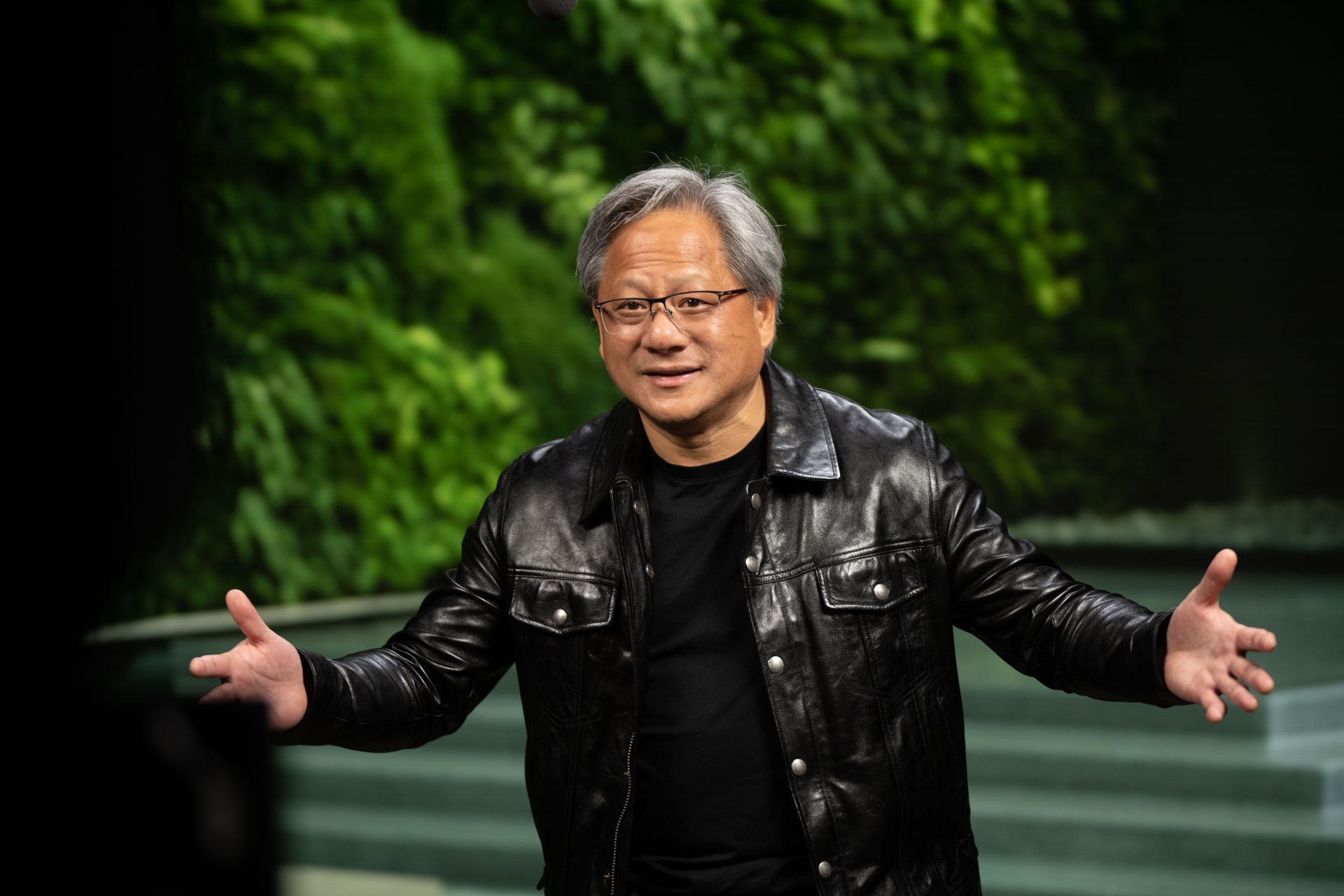
Image: An image from the body of the MyDrivers article about NVIDIA’s declining market share in China (Source: MyDrivers)
Key News
Compute-in-memory chip company MemSilicon raises over RMB 400 million in Series A funding, names former Graphcore executive Lu Tao CEO
Sina Tech reported on the afternoon of October 19 that MemSilicon announced it had raised more than RMB 400 million in Series A funding [2]. The round was led by Boyuan Capital, with participation from Bosch Ventures, miHoYo, GigaDevice and others, while existing investors including Xiaomi's strategic investment arm and CAS Star increased their investments [2]. The company also announced that Lu Tao, former president and general manager of Greater China at Graphcore, had joined as CEO and co-founder. He brings more than 20 years of experience in the chip industry [2]. According to the report, the funding will support the commercialization of RRAM, a new type of nonvolatile memory, and the development of next-generation LPUs [2].
Why it matters: As Nvidia's market share shrinks, investors are betting on non-GPU approaches such as compute-in-memory. The participation of both corporate investors and gaming companies suggests that downstream users are also moving early to secure computing capacity.
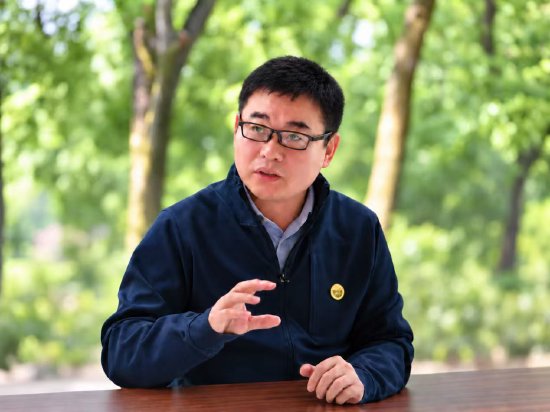
Image: Illustration accompanying the MemSilicon funding news (Source: Sina Tech)
State Administration for Market Regulation releases first three standardization technical documents for large AI models in the steel industry
According to Jiemian News, citing CCTV News, the State Administration for Market Regulation has released three national standardization guidance technical documents: Artificial Intelligence—Guidelines for Classifying Application Scenarios in the Steel Industry, Artificial Intelligence—Technical Requirements for Datasets for Large AI Models in the Steel Industry, and Artificial Intelligence—Service Capability Maturity Assessment for Large AI Models in the Steel Industry [3]. The documents respectively specify how to classify application scenarios, build training datasets, and rate service capabilities, forming a complete framework spanning scenario classification, dataset specifications, and maturity assessment [3]. The dataset document sets technical requirements for raw data aggregation, data cleansing and governance, knowledge integration, training sample preparation, and data security [3].
Why it matters: This marks a step toward a common evaluation framework for industry-specific large AI models, moving beyond each provider's own claims. Steel companies now have reference standards for procuring and accepting large-model services, while other heavy industries gain a template to follow. Note that these are guidance technical documents, not mandatory standards.
Daxiao Robotics releases embodied foundation model ACE-Brain-0.6, claims it outperforms GPT-6 Astra on multiple spatial perception benchmarks
According to IT Home, Daxiao Robotics has released ACE-Brain-0.6, an embodied foundation model developed through supervised fine-tuning of Qwen3.5-9B, with a focus on improving object recognition, spatial localization, and identification of interaction regions [4]. The company says the model was trained on approximately one million spatial grounding examples and outperformed OpenAI GPT-6 Astra on six of eight grounding evaluations, which test the ability to map language descriptions to specific locations in an image. It averaged 74.53 points across seven public benchmarks, compared with GPT-6 Astra's 73.68, and scored 94.13 on RobotGrounding, an evaluation based on real-world robotics scenarios [4].
Why it matters: A 9B-parameter open-source base model can match leading closed-source models in specialized capabilities after targeted fine-tuning, suggesting that competition in embodied AI hinges on data and use cases. These results were disclosed by the company and have not been independently verified.
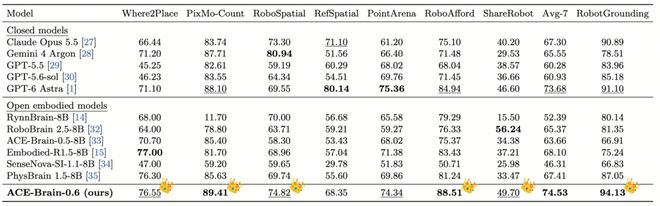
Figure: ACE-Brain-0.6 outperforms GPT-6 Astra on six of eight grounding benchmarks (Source: IT Home)
AI Computing Capacity Expansion Drives China's Power Equipment Exports
Reporting from the Canton Fair, Yicai cited International Energy Agency (IEA) data indicating that global AI data centers will consume three times as much electricity in 2030 as in 2025 [5]. Data from PJM, the largest power grid operator in the United States, shows that major transmission projects take more than three years on average to secure a grid connection agreement, followed by roughly another four years after approval before they can come online [5]. Wang Jun, deputy head of the General Administration of Customs, said that the operation of large-scale computing infrastructure is driving global demand for power equipment; China's exports of rechargeable batteries rose 34.8% in the first three quarters [5].
Why it matters: Slow grid connections have become a bottleneck for data centers outside China, making on-site power generation and energy storage alternative solutions and creating new export demand for Chinese manufacturers of transformers, energy storage systems, and power generation equipment.
By the Numbers
- 34%: NVIDIA's share of China's data center AI chip market in the first half of 2026 (IDC) [1]
- 678,000 chips: NVIDIA's data center AI chip shipments in China over the same period, down 44% year over year [1]
- 180 million fiber-kilometers: TrendForce's projected global optical fiber supply shortfall in 2026 [6]
- KRW 3 trillion: Amkor's investment in expanding advanced packaging capacity in Gwangju [7]
- 3×: The IEA's projected ratio of global AI data center electricity consumption in 2030 to that in 2025 [5]
News Briefs
- TrendForce: AI data centers are driving up demand for optical fiber. Spot prices for finished optical fiber are expected to rise 2.8-fold to more than fivefold year over year in 2026, with supply constraints potentially lasting through 2028. [6]
- Amkor: The company broke ground on an expansion project at its Gwangju facility in South Korea. The first two buildings are scheduled for completion in the second half of 2027, followed by two more in the first half of 2028. [7]
- Tencent Hunyuan: According to Zimubang, Hunyuan used the Terminal-RSI method to train Alibaba's Qwen base model, raising its Terminal-Bench 4.0 score from 0 to 19.8% and doubling its average score across four tests. [8]
- BYD: At an extraordinary shareholders' meeting, Wang Chuanfu disclosed that the company has a chip R&D team of more than 7,000 people, has invested over RMB 100 billion in chips to date, and operates five wafer fabs. [9]
- Shenzhen: The Shenzhen Municipal Committee of the Chinese People's Political Consultative Conference held a special consultation on the AI industry. Members called for coordinated progress in five areas, including data access, computing infrastructure and training corpora, and talent recruitment and development. [10]
Editor's Take
Notably, several seemingly unrelated stories today point to the same development: AI computing bottlenecks are spreading beyond chips to the entire supply chain. NVIDIA's declining market share in China is creating room for domestic chipmakers with new architectures, such as MemSilicon. Overseas, meanwhile, data centers are increasingly constrained by grid connections, optical fiber, and advanced packaging capacity. Amkor's expansion, multifold increases in optical fiber prices, and growing exports of power equipment all reflect this pressure. We believe that assessing the outlook for AI infrastructure will increasingly require looking beyond GPU shipments to orders and pricing at companies in power, optical communications, and packaging—businesses not typically considered “AI companies.” Meanwhile, standards for large AI models in the steel industry and targeted fine-tuning of embodied AI models indicate that competition on the application side is shifting toward data quality and industry standards with verifiable acceptance criteria.
References
- After Market Share Falls to 34%, Jensen Huang Says NVIDIA “Absolutely Must” Work with Chinese Companies — MyDrivers, accessed 2026-10-19
- MemSilicon Announces Over RMB 400 Million in Series A Funding, Names Chip Industry Veteran Lu Tao CEO — Sina Tech, accessed 2026-10-19
- Building a Complete Closed Loop: First Batch of Standards for AI-Empowered Steel Industry Released — Jiemian News, accessed 2026-10-19
- Daxiao Robotics Unveils Embodied Foundation Model ACE-Brain-0.6, Surpassing OpenAI GPT-6 Astra on Six Spatial Perception Benchmarks — IT Home, accessed 2026-10-19
- AI Ultimately Runs on Electricity: Overseas Computing Center Expansion Fuels Chinese Energy Equipment Exports | 70 Years of the Canton Fair — Yicai, accessed 2026-10-19
- Industry Analysts: Fiber-Optic Spot Prices Rise Severalfold in 2026; Supply Shortfalls Driven by Data Center Demand Could Last Until 2028 — Gelonghui, accessed 2026-10-19
- Amkor Plans to Invest KRW 3 Trillion over the Next 5 Years to Expand Advanced Packaging Capacity in Gwangju, South Korea — IT Home, accessed 2026-10-19
- Using Alibaba as Its Foundation, Tencent Hunyuan Achieves “Small-Scale RSI” — Zimubang, accessed 2026-10-19
- Wang Chuanfu’s Advice to Young People: Dream Big While You’re Young — MyDrivers, accessed 2026-10-19
- Advancing Full-Stack Innovation and Applications Across All Domains! Shenzhen Party Secretary and CPPCC Members Discuss High-Quality Development of the AI Industry — CPPCC Daily, accessed 2026-10-19