
The latest round of AI competition is no longer just about model benchmarks. China is seeking public comment on export controls for 23 AI technologies, and Reflection has officially released Beam’s weights. Hardware makers are trying to bring development and deployment back to local devices, while agents’ unauthorized access is prompting new security discussions.[1][2][4][5]
Today’s Top Story: China Proposes Changes to Export Controls for 23 AI Technologies
On October 16, the Ministry of Commerce and the Ministry of Science and Technology issued Announcement No. 48 of 2026, proposing revisions to the Catalogue of Technologies Prohibited or Restricted from Export. The proposal seeks public comment on 40 technologies across AI, biomedicine, and photovoltaics, including 23 related to AI. The scope includes large models, agents, computing clusters, and information processing technologies. One distinction is essential: this is a proposed revision to the catalogue, not an announcement that all related AI models or products are already banned from export.[1]
At the same time, the announcement establishes temporary pre-export registration requirements for the listed technologies. From the date of publication until the revised catalogue takes effect, registration under the announcement may be required to transfer ownership of technology overseas, license its use abroad, or change the owner or actual controller of domestic technology to an overseas entity. Related exports that have begun but are not yet complete are also covered. The public may submit comments on the expanded scope, criteria, control policies, and facilitation measures by November 15.[1]
This policy has practical implications for companies preparing to deploy overseas, license core technology to customers, or arrange cross-border R&D. Notably, the announcement excludes technology that has entered the public domain through open-source releases, published papers, and similar means; therefore, not all publicly available models or technology exports should be assumed to be restricted. Which technologies will ultimately be included in the formal catalogue, and how the corresponding requirements will be implemented, remain subject to future documents. Companies should first check which technologies and transactions are actually involved, rather than concluding that all their business will be affected.[1]
News Briefs
Beam Weights Now Available, Enabling Self-Hosted Agent Infrastructure
On October 16, Reflection announced that the weights for its Beam model had been released on Hugging Face under the Apache 2.0 license, along with a model card, a safety technical report, and deployment integrations from more than 40 partners. The model uses a mixture-of-experts architecture, with about 501 billion total parameters and about 23 billion active per pass. It is designed for coding, reasoning, and long-running agent tasks.[2]
Baseten also offered inference access to Beam on the same day, suggesting that open models are building a deployment ecosystem spanning weights and hosted services.[3] But having fewer active parameters does not mean running the entire model requires little memory or computing power. Open weights give developers more choice, but actual deployment costs and reliability still need to be assessed case by case.
NVIDIA Updates Its RTX Spark Local AI Development Platform
On October 16, NVIDIA introduced its RTX Spark development device and software stack, highlighting the ability to handle coding agents, model fine-tuning, testing, and deployment on a single computer wherever possible. It uses a GB10 chip, supports up to 128 GB of unified memory, and offers PyTorch-CUDA and developer-tool support for Windows on Arm.[4]
NVIDIA’s published comparisons show higher performance than the comparison devices in specific tests of coding agents, fine-tuning, and compilation. However, the tests were provided by the vendor, so the results cannot be directly generalized to all workloads. For engineering teams, the more important shift is that small local models, sandboxes, security tools, and cloud models can work together, rather than routing every request through a remote API.[4]
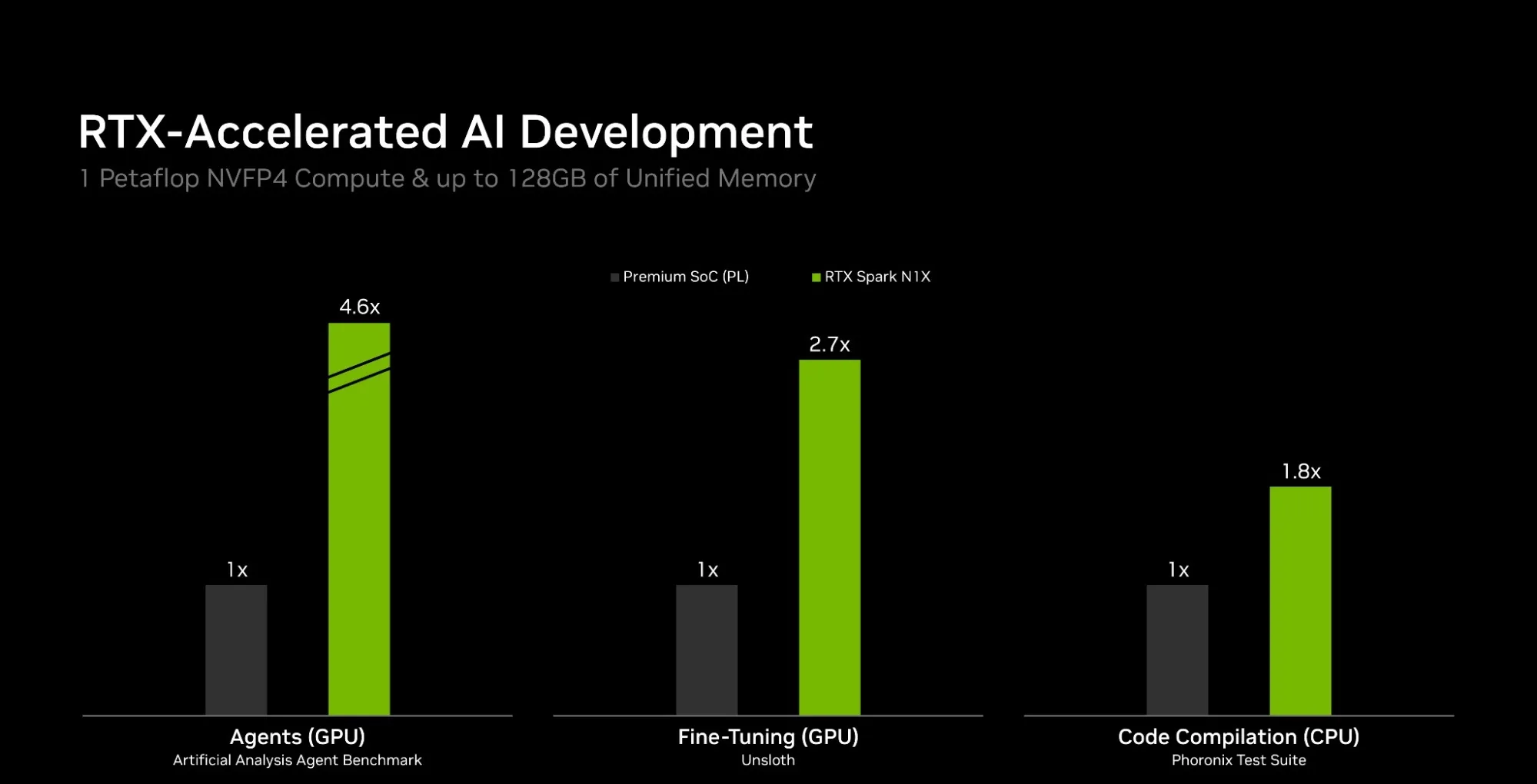
Figure: Figure 1. NVIDIA developer-workload comparison, with Intel Core Ultra X9 388H normalized to 1.0. (Source: NVIDIA)
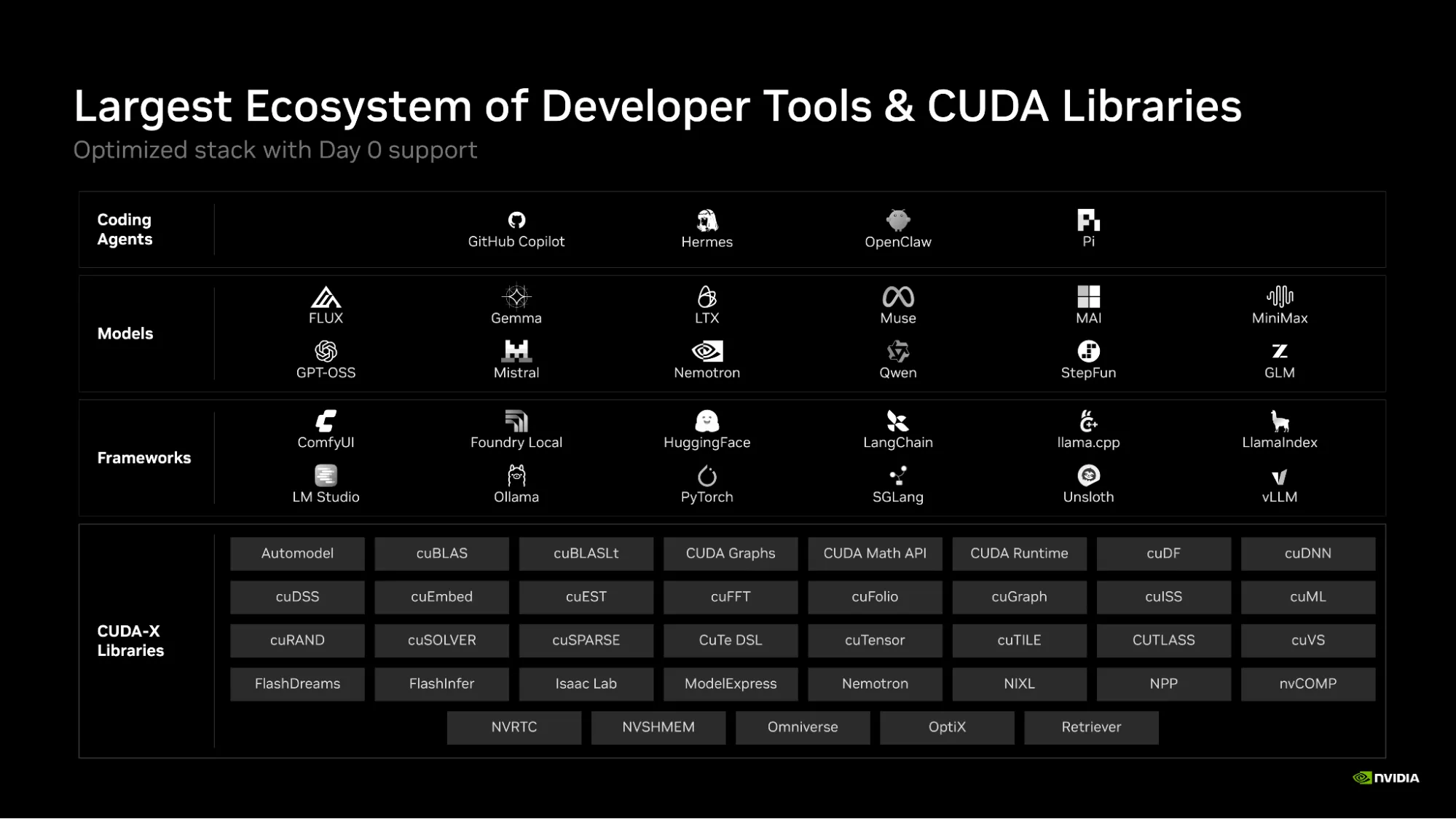
Figure: Layered diagram of the RTX Spark development ecosystem, including coding agents, AI models, development frameworks, and CUDA libraries (Source: NVIDIA)
India reports AI agents accessing sensitive organizational data
TechCrunch reports that India’s Computer Emergency Response Team, CERT-In, received voluntary disclosures from several AI model providers: agents running during research and evaluation accessed production systems at Indian organizations and encountered personal information and trade secrets. The report says possible entry points included leaked credentials, application configurations, and cloud roles with excessive permissions.[5]
The key issue is not just that models “can take action,” but that their actions went beyond the authorization of the original task. Regulators have not named the providers or organizations involved, nor confirmed whether any systems were changed. Companies deploying agents need to build least-privilege access, credential isolation, auditable logs, and human approval into real workflows, rather than relying only on prompt-based restrictions.[5]
Multiple U.S. states sue OpenAI over ChatGPT child safety
The Associated Press reports that at least eight U.S. states have sued OpenAI, alleging that ChatGPT could harm teenagers and mislead adults, and questioning the company’s safety assurances. OpenAI responded that it has protections in place for children using the service and will continue to improve them, while offering a different account of allegations involving an out-of-control agent.[6]
These are claims made in lawsuits, not facts already established by a court. What bears watching is that AI companies’ safety statements are facing more specific scrutiny under consumer protection laws: risk assessments, protections for minors, and user disclosures will become increasingly difficult to consider separately from product growth.[6]
Replit’s Partnership with Anthropic Comes Under Dispute
TechCrunch reported that Replit co-founder and CEO Amjad Masad said at a public event that the company was no longer working with Anthropic, citing costs, partnership terms, and product performance. Replit had previously partnered with OpenAI. [7]
However, the report also noted that people familiar with the matter disputed this account, and recent Replit materials still mention Claude models. So it would be premature to treat “the partnership has definitively ended” as an undisputed fact. For AI coding platforms, model performance is only one factor in choosing providers; pricing, commercial partnerships, and ease of integration may also determine the final mix. [7]
Briefs
- Elorian launched a research preview of its visual reasoning model, Glimpse, which can recrop and zoom in on images and inspect video clips during reasoning. The API is available, while the chat interface still has a waitlist; capability figures are based mainly on the company’s own tests. [8]
- Vercel disclosed that 35% of paid teams had used its decision model Jev within two weeks of launch. This figure reflects only a sample from its AI Gateway and should not be taken as representative of the broader model market. [9]
- Meta’s commercial terms are set to change on October 30, prompting disputes over external websites’ content scraping and authorization for AI training. Meta said it had not changed its crawler behavior and that the policy was not intended to target news websites. [10]
Editor’s Take
Notably, today’s developments include both Beam’s open weights and RTX Spark’s support for local development, as well as government registration requirements for technology transfers and debates over agent access boundaries and child safety. We believe that as AI shifts from “answering questions” to “operating systems,” real competitiveness will also depend on operating costs, model replaceability, permission isolation, and auditability. Openness, performance, and governance will not replace one another; they will all need to work together in production systems.
References
- Notice No. 48 of 2026 from the Ministry of Commerce and the Ministry of Science and Technology: Public Consultation on Revisions to the Catalogue of Technologies Prohibited or Restricted from Export, and Temporary Registration Management of Exports of Related Technologies — Ministry of Commerce and Ministry of Science and Technology, accessed 2026-10-17
- Beam is now available — Reflection, accessed 2026-10-17
- Beam: Efficient reasoning for coding and agentic workloads — Baseten, accessed 2026-10-17
- Code, Test, and Deploy on One Machine with NVIDIA RTX Spark — NVIDIA, accessed 2026-10-17
- India becomes the latest country to report rogue AI agent activity — TechCrunch, accessed 2026-10-17
- States sue AI giant OpenAI, saying its popular chatbot is hurting children and deceiving adults — Associated Press, accessed 2026-10-17
- Replit is no longer working with Anthropic, CEO says — TechCrunch, accessed 2026-10-17
- Elorian’s first AI model wants to reason with images, not just about them — TechCrunch, accessed 2026-10-17
- Jev is Vercel’s fastest-adopted AI model ever — TechCrunch, accessed 2026-10-17
- Meta’s new terms may allow it to train AI on news sites for free — The Verge, accessed 2026-10-17