
This afternoon's biggest development is DeepSeek's open-sourcing of its internal inference framework, DeepInfer, offering a first public look at the layer that makes large models affordable to run. The other major theme is demand for computing power and chips: China's Ministry of Industry and Information Technology reported 146% year-over-year growth in AI computing power, while Montage Technology and memory manufacturers are benefiting from the AI server boom.
Top Story: DeepSeek Open-Sources Its DeepInfer Inference Framework
What happened. According to IT Home, DeepSeek announced that it is fully open-sourcing its internal inference framework, DeepInfer [1]. An inference framework is the software layer that deploys trained models as online services. DeepSeek says DeepInfer has enabled it to deliver large-scale inference services for DeepSeek V4.1 Flash with high throughput and low latency [1]. The GitHub project description calls DeepInfer a high-performance inference framework powering DeepSeek's large-scale production services. The open-source release provides the core functionality needed for offline inference and serving at scale, under the Apache 2.0 license [2].
Background. DeepSeek notes in its article that a model's capabilities are defined by the model itself, but delivering services at massive scale at a reasonable cost also depends on a middle layer that has long remained out of public view: the inference framework [1]. In the past, the open-source community mostly received model weights; the inference systems leading companies actually use for online services were rarely made public.
Impact. For developers and cloud providers, this means direct access to the engineering practices behind DeepSeek's online services—not just the model. Notably, the supported hardware listed in the project description includes both NVIDIA SM100 GPUs and Huawei Ascend 950 NPUs [2], making this practically relevant for businesses looking to deploy large models on Chinese-made computing hardware.
Open questions. The performance figures in the project description were measured under specific configurations: four SM100 GPUs for prefill and 64 for decoding [2]. Most businesses would struggle to reproduce those results with their available hardware. DeepSeek-V4.1-Flash is currently the only supported model [2], and whether the community can adapt the framework to other models remains to be seen.
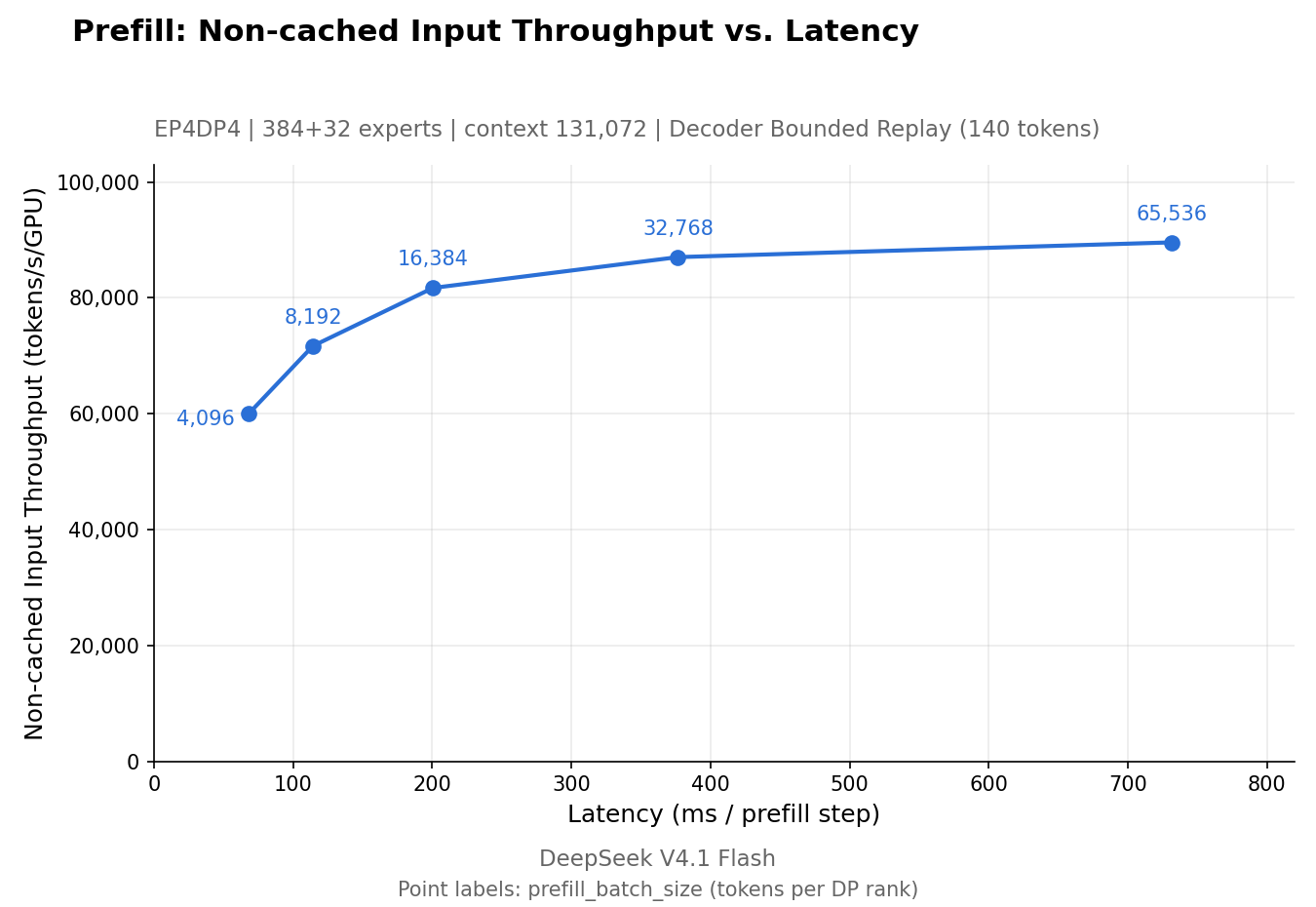
Chart: Prefill: non-cached input throughput vs. latency (Source: DeepSeek (GitHub))
News Highlights
MIIT: AI computing capacity reaches 2,592 EFLOPS; over 100 AI devices meet L3 requirements
Data from the Ministry of Industry and Information Technology (MIIT) shows that China's AI computing capacity reached 2,592 EFLOPS by the end of September 2026, up 146% year over year [3]. EFLOPS measures computing capacity in quintillions of floating-point operations per second. On the same day, MIIT also said that more than 100 AI device products meet L3 assistance-level capability requirements, enabling them to understand complex intent and proactively serve users. These products span smartphones, computers, TVs, glasses, vehicle cockpits, headphones, and other categories [4]. Total profits in the electronic information manufacturing sector reached RMB 847.5 billion from January through August, up 109.9% year over year [4].
Why it matters: Taken together, the computing capacity and device figures show that AI is driving both infrastructure investment and consumer electronics upgrades, with official data backing demand for the hardware companies involved.

Image: Illustration accompanying a report on MIIT's telecommunications industry performance data (Source: People's Posts and Telecommunications News (Sina Tech))
Montage Technology: Third-quarter net profit projected to rise by up to 175%
Montage Technology announced that it expects net profit attributable to shareholders of the parent company for the third quarter of 2026 to reach RMB 1.20 billion to RMB 1.30 billion, up 153.6% to 174.7% year over year [5]. The company attributed the increase to the rapid development of AI inference and agent applications, which has driven demand for server CPUs and significantly increased shipments of DDR5 memory interface chips and companion chips for memory modules [5].
Why it matters: This is direct evidence that AI demand is spilling over beyond GPUs into CPUs and memory support chips, as inference and agent applications reshape the mix of server purchases.
Tencent WorkBuddy leads AI office products with 32.35 million monthly active users
Citing ranking data, MyDrivers reported that Tencent WorkBuddy reached a combined 32.353 million monthly active users, up 647.1% quarter over quarter [6]. Second-place Baidu Dazi had 9.77 million monthly active users and the highest quarter-over-quarter growth of any product at 1,567.5%; Alibaba Qianwen Office ranked third with 7.905 million monthly active users [6].
Why it matters: AI office products from major tech companies are scaling rapidly, while the gaps in rankings and growth rates show that this market is still far from settled—something both businesses choosing products and developers should watch.
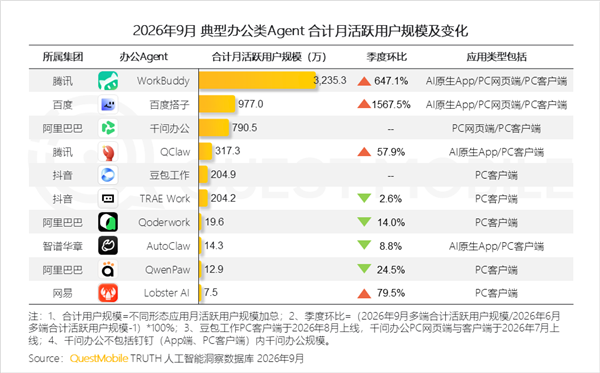
Image: Screenshot of AI office product rankings by monthly active users (Source: MyDrivers (Sina Tech))
Micron’s Taiwan Union Plans Strike to Seek a Share of the AI Memory Boom
The Next Web reports that bonus negotiations between Micron’s Taiwan employees and the company have broken down, and the union is planning a strike [7]. The report notes that the dispute centers on bonuses rather than base pay; Micron’s South Korean rivals Samsung and SK hynix already tie bonuses to company profits [7]. The Taichung union has yet to hold its own strike vote [7].
Why it matters: AI-driven increases in memory prices have sharply boosted chipmakers’ profits, and employees are demanding a share of the gains. Labor relations could become a new factor affecting memory supply.
By the Numbers
- 2,592 EFLOPS: China’s AI computing capacity as of the end of September, up 146% year over year [3]
- Over 100: AI device products meeting L3 assistance-level requirements [4]
- RMB 1.2–1.3 billion: Montage Technology’s projected third-quarter net profit attributable to shareholders of the parent company [5]
- 32.353 million: Total monthly active users of Tencent’s WorkBuddy [6]
- Approximately $1.1 billion: Maximum milestone payments under METiS Tech’s collaboration with Eli Lilly [10]
News Briefs
- Nomura Securities: Maintains Buy ratings on Samsung Electronics and SK hynix, with price targets of KRW 670,000 and KRW 4.7 million, respectively, and views concerns about Chinese memory manufacturers catching up as overblown [9]
- Elice: The South Korean AI cloud company fell on its first day of trading on KOSDAQ, as strong subscription interest failed to carry over into the secondary market [8]
- METiS Tech: Reached a collaboration agreement with Eli Lilly on AI-driven LNP delivery technology, with an upfront payment exceeding $10 million and potential milestone payments of up to approximately $1.1 billion [10]
- Ministry of Transport: Released its first set of guidelines for AI application scenarios in waterway transport, along with plans for ten AI agents and ten domain-specific models to be completed in 2027 [11]
- Guangdong Cyberspace Administration: Seven more generative AI services have completed registration in Guangdong, bringing the total to 108 [12]
- Ministry of Foreign Affairs: Responding to the U.S. government’s demand that agencies stop using DeepSeek, expressed opposition to politicizing technology, economic, and trade issues [13]
- Metis: An AI company founded in London by former Google DeepMind researchers advocates an alternative to the “bigger models, bigger training budgets” approach [14]
- GMO: The Japanese security company says it identified six servers launching AI-driven attacks, while the Japanese government urged businesses to strengthen their cyber defenses [15]
Editorial Perspective
Taken together, today’s developments suggest that the focus of AI competition is shifting from “whose model is more powerful” to “who can run models more cheaply and reliably.” DeepSeek’s open-source inference framework and Metis’s emphasis on computational efficiency both point to the same issue: inference costs. Meanwhile, inference demand is already rippling through CPUs, memory interface chips, and storage. Montage Technology’s results, Nomura’s assessment of memory shortages, and Micron’s labor dispute all reflect effects along this supply chain. Notably, DeepInfer supports both NVIDIA and Ascend. As external restrictions mount, software compatibility could become key to putting China’s domestic computing capacity to work.
What to Watch Next
- October 22: The planned date for the Micron Taiwan union strike. Watch whether it proceeds as scheduled and how it affects production [7]
Sources
- DeepSeek announces plans to fully open-source its internal inference framework DeepInfer, aiming to make large AI models accessible to all — IT Home, accessed on 2026-10-20
- deepseek-ai/DeepInfer — DeepSeek (GitHub), accessed on 2026-10-20
- MIIT: AI computing capacity grows 146%, industrial private 5G networks exceed 26,000… telecommunications industry maintains steady growth — People's Posts and Telecommunications News (Sina Tech), accessed on 2026-10-20
- MIIT: Flagship AI phones and PCs can now execute tasks autonomously on-device as AI devices shift from "passive responses" to "proactive services" — Red Star News (Sina Tech), accessed on 2026-10-20
- Server CPU demand rises; Montage Technology forecasts third-quarter net profit growth of 154%–175% year over year — Caiwen (Tonghuashun), accessed on 2026-10-20
- Tencent's WorkBuddy takes the top spot: Monthly active users surpass 32 million, soaring 647% month over month — MyDrivers (Sina Tech), accessed on 2026-10-20
- Micron workers in Taiwan to strike as bonus talks with chipmaker fail — The Next Web, accessed on 2026-10-20
- Elice shares fall in KOSDAQ debut after $151M IPO — TechNode Global, accessed on 2026-10-20
- Nomura Keeps Buy on Samsung, SK hynix, Sees Memory Shortage Through 2028 — Seoul Economic Daily, accessed on 2026-10-20
- METiS Tech and Eli Lilly form strategic partnership to advance next-generation tissue-specific LNP delivery technology — Caiwen (Sina Finance), accessed on 2026-10-20
- First guidelines on AI application scenarios in waterway transportation released — Yicai (Sina Finance), accessed on 2026-10-20
- Guangdong adds seven newly registered generative AI services — Jiemian News (Sina), accessed on 2026-10-20
- Foreign Ministry responds to U.S. government requirement for agencies to stop using DeepSeek: China opposes politicizing technology, economic, and trade issues — IT Home, accessed on 2026-10-20
- Former Google DeepMind top researcher launches London “compute-efficient” AI company — Tech.eu, accessed on 2026-10-20
- Chinese AI tool behind cyberattacks in Japan: security firm — The Korea Times, accessed on 2026-10-20