
Over the past seven days, the most notable development across search platforms has not been some mysterious ranking algorithm, but concrete product changes in how AI answers give visibility to original web pages. Google is making source links more prominent in AI search, while Bing is organizing cited queries into topic groupings. Meanwhile, new research offers a reminder for businesses: a brand being mentioned by AI in the US does not mean it is equally visible in the UK or in Southeast Asian language markets.[1][2][3]
This Week's Top Story: Google Changes Source Link Placement in AI Search
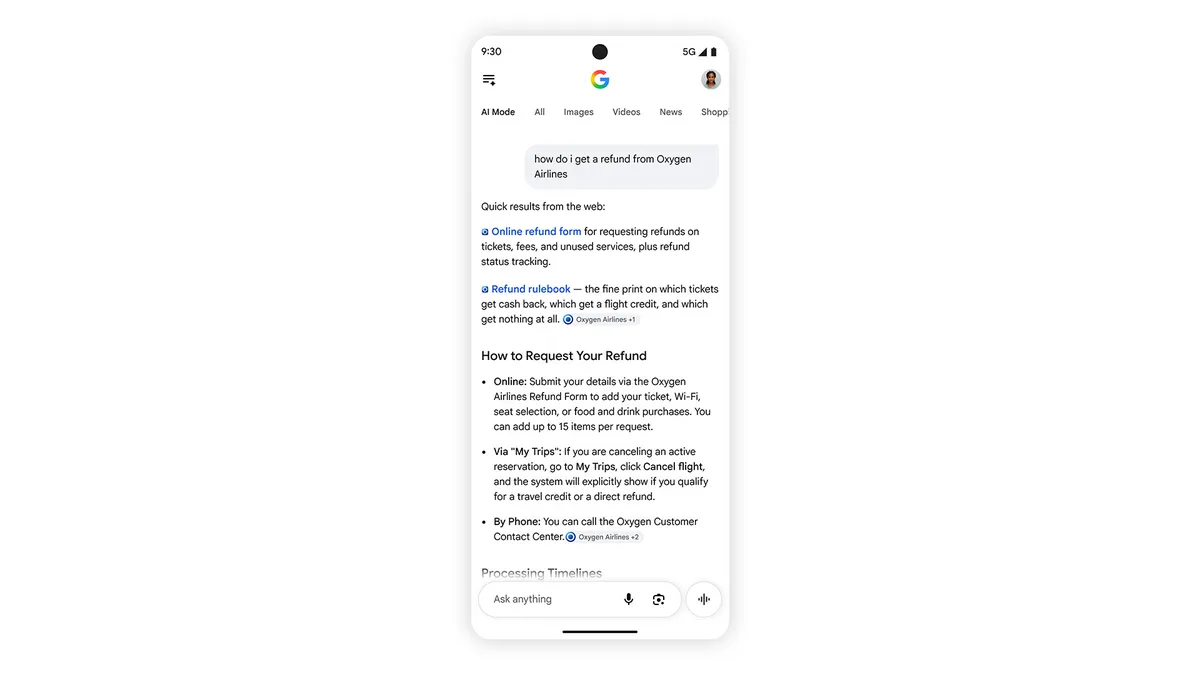
On October 15, Google announced a series of changes to how users access sources in AI Mode and AI Overviews. First up are inline links: Google says it has continued to add more embedded links to AI answers and has begun placing important links near the beginning of responses more frequently, rather than concentrating citations at the end. For users, this removes a step between reading an answer and visiting the original web page. For publishers and corporate websites, the question is not just whether they appear in the answer, but where the citation appears and whether users can spot it at a glance. Google announced these changes directly, but that does not mean they have been rolled out simultaneously across all countries and queries.[1]
Second, for queries with a clear official destination, Google will test a dedicated section above the answer featuring links to official websites, along with context explaining why each link is useful. This design serves situations where users specifically want to visit an organization's website, product documentation, or a service portal, rather than simply presenting the traditional ten blue links. It could create more opportunities for users to click directly through to authoritative sources, but a test should not be taken to mean that having an official domain guarantees inclusion in AI answers. Page structure, content credibility, and search intent still need to be evaluated individually.[1]
The third change focuses on news and creators. Google is expanding carousel cards that highlight timely articles in AI search to more regions and languages, while also making thumbnails and clickable links for related articles at the end of answers more prominent. In some AI Mode video results, creator and publisher names can link to search profile pages. The phrase “more regions and languages” is particularly relevant to businesses operating across borders: potential entry points for multilingual content are increasing, but Google has not provided a language-by-language rollout list or promised higher click-through rates. Website managers should monitor the actual interface for their language versions in each market.[1]
Importantly, this update changes presentation and discovery paths; it should not be equated directly with changes to indexing, ranking algorithms, or AI citation weighting. For businesses, the actionable step is to check whether key product pages, company overviews, and support documentation answer users' questions clearly enough and are readily identifiable as official sources. Content teams should measure brand mentions, page citations, whether citations are clickable, and actual website visits separately. It remains to be seen whether these visibility changes will translate into real traffic and conversions, rather than simply looking more prominent in screenshots.[1]
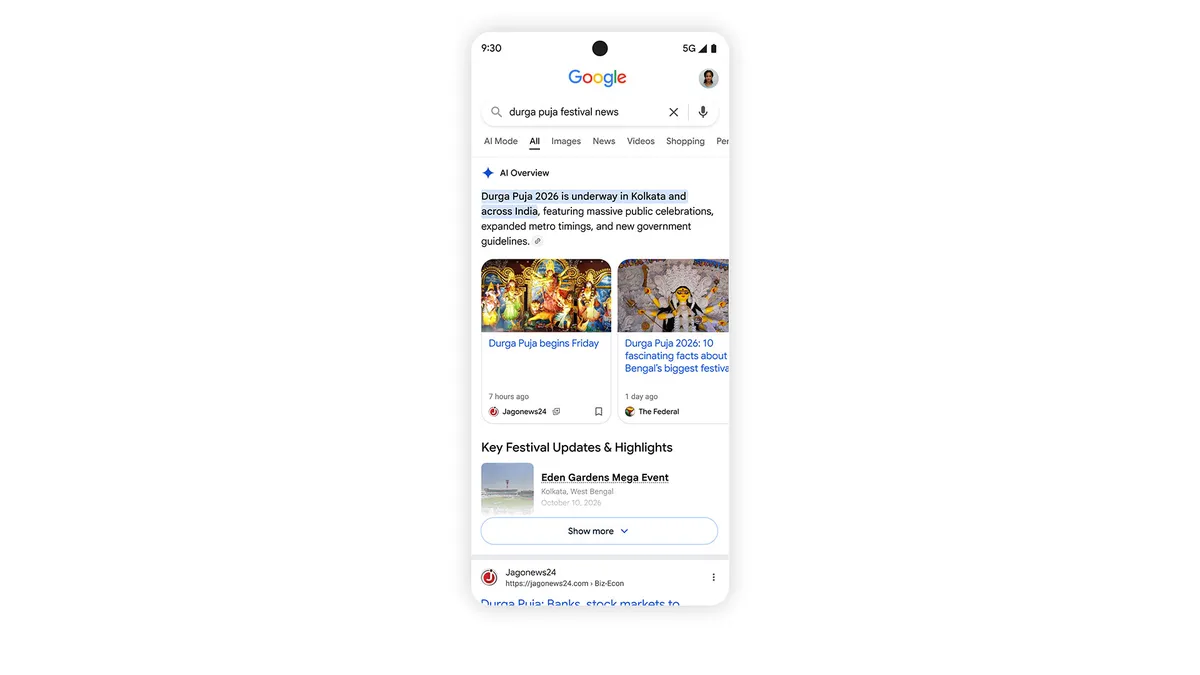
Figure: Illustration of article links and thumbnails in Google AI search (Source: Google)
Top Stories
Bing Expands AI Citation Tracking from Individual Queries to Topic Portfolios
On October 13, Microsoft launched the Topics Portfolio beta in Bing Webmaster Tools, integrated into the AI Performance report. It groups grounding queries (queries used by the model to retrieve supporting information) for which a site appeared in AI answers into topics, and displays three estimated metrics: Topic Size, Sites Cited, and Queries. It also highlights opportunity queries where competitors were cited but your site was not. Unlike traditional keyword ranking tracking, this lets websites identify gaps in content coverage at the topic level.[2]
Microsoft cautions that this is still a beta: topics are classified by AI, the data is approximate, and citation counts for opportunity queries are shown as ranges. Sites with too little data may not see the panel at all. Why it matters: this offers a more direct way to monitor AI citations, but the panel's figures should not be treated as precise traffic counts or actual conversions. We recommend tracking high-value topics separately by market and language rather than blindly pursuing every opportunity query.[2]
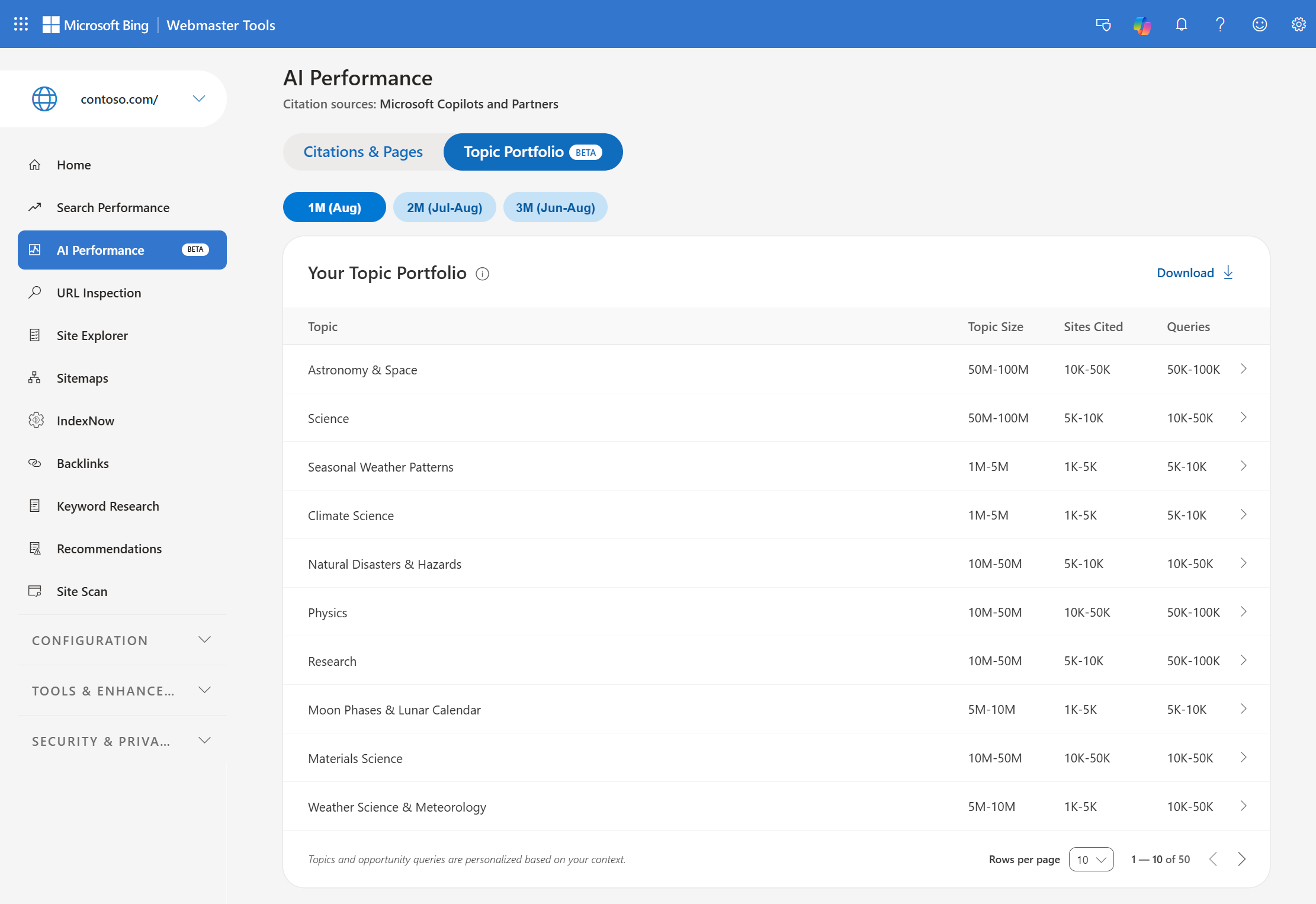
Figure: Screenshot of the Topics Portfolio list in Bing Webmaster Tools' AI Performance report (Source: Microsoft Bing)
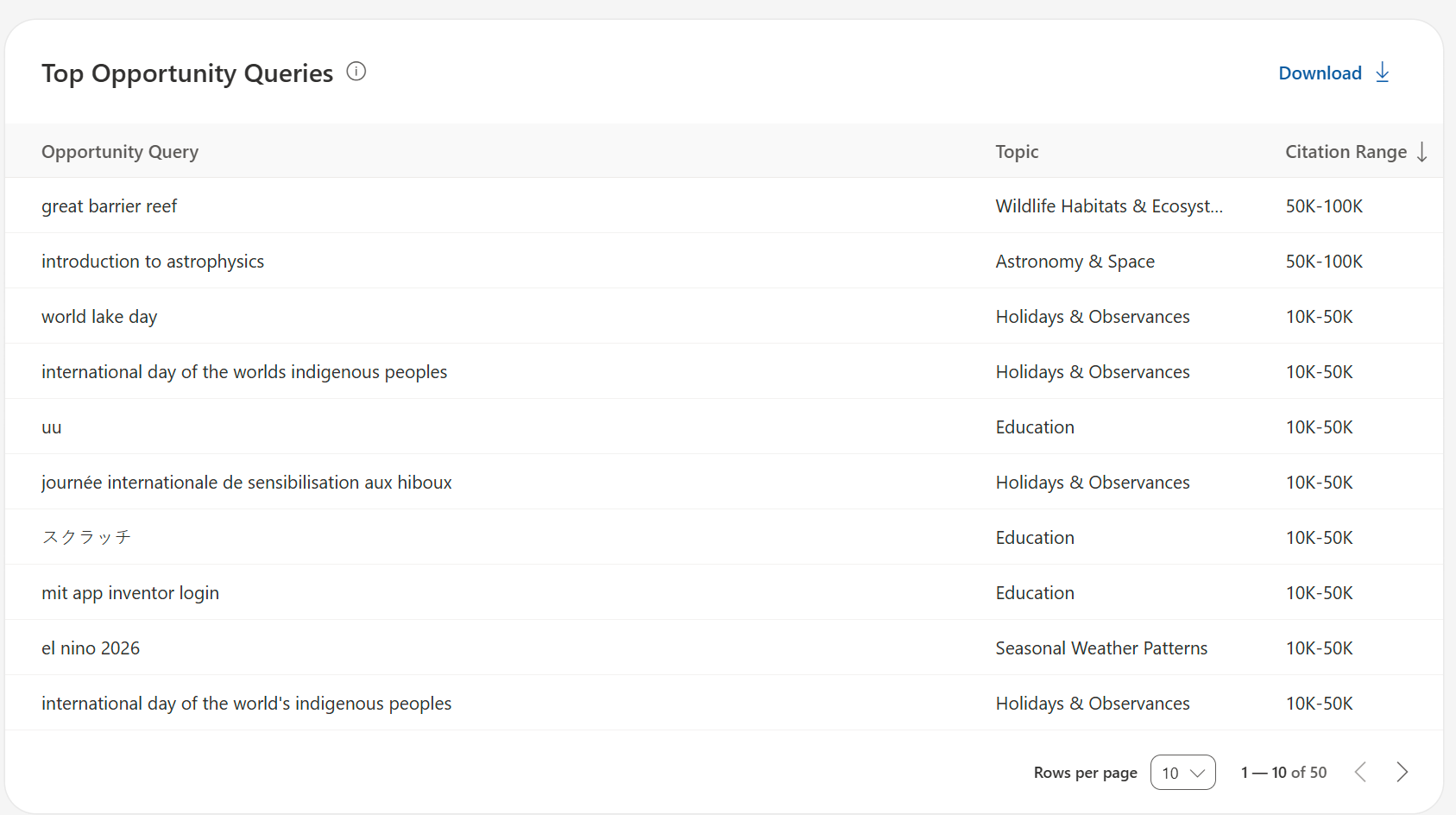
Figure: Screenshot of the Top Opportunity Queries list in Bing Topics Portfolio (Source: Microsoft Bing)
New Semrush Benchmark Shows AI Brand Visibility Does Not Carry Over Between the UK and US
On October 13, Semrush released a UK–US comparison in its updated AI Visibility Index. The report analyzes seven months of data from January through July 2026, using a fixed monthly sample of approximately 2.5 million prompts in the UK and 25 million in the US, and compares results across ChatGPT, Gemini, Google AI Mode, and AI Overviews. The study finds that AI platforms are less consistent in their mentions of popular brands in the UK than in the US; only 15 domains consistently appear in the shared core list across both markets.[3]
These figures reflect the study’s own sampling methods and definitions and should not be interpreted as exact proportions of all real user queries worldwide. Why it matters: Multilingual websites should not simply copy a US English GEO strategy. British English, local media and community sources, and brand entity information can all affect how often a brand is mentioned or cited; Southeast Asian language markets, in particular, need their own baselines.[3]
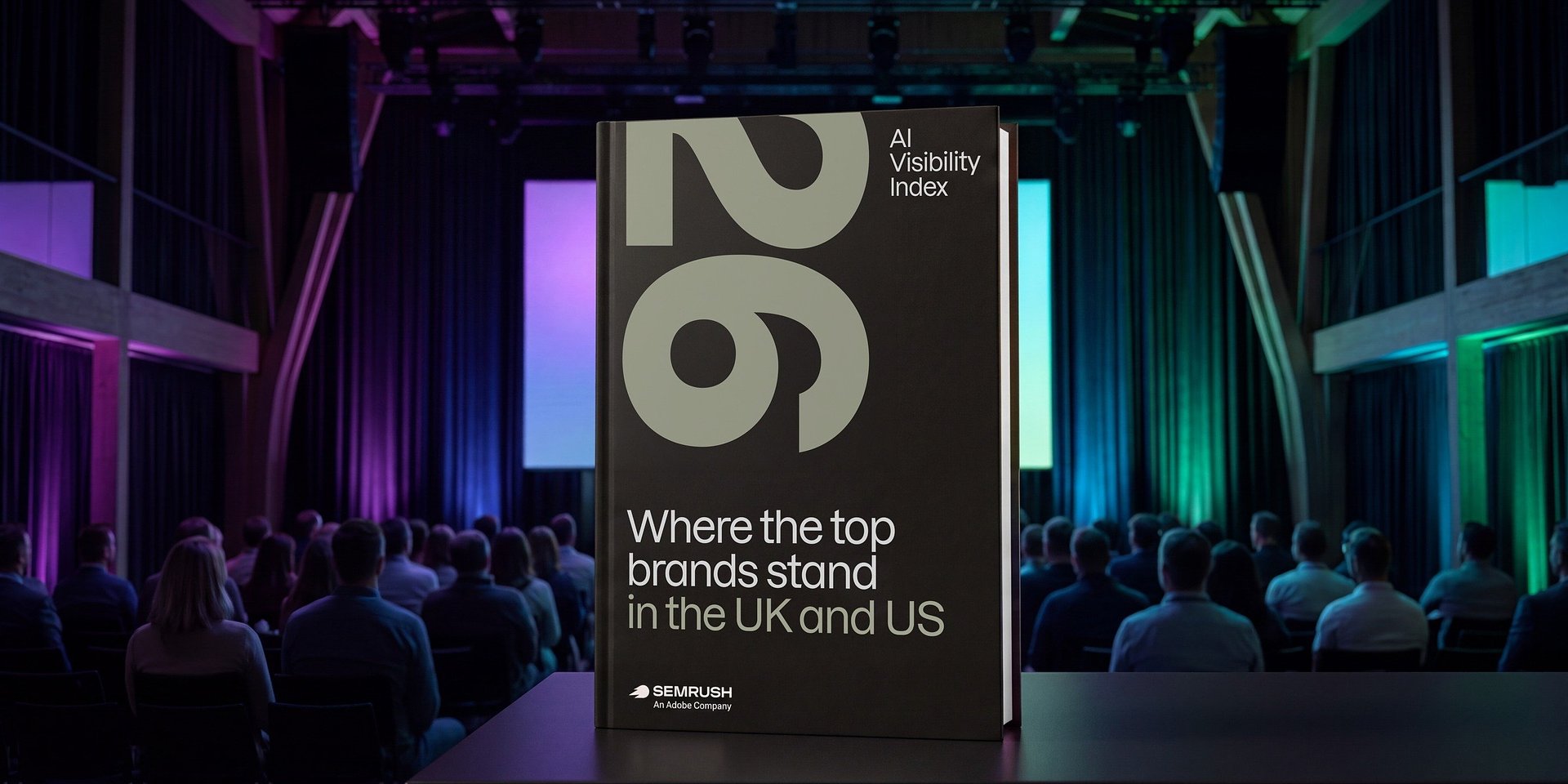
Image: Official campaign visual for the Semrush 2026 AI Visibility Index report comparing UK and US brand visibility (Source: Semrush)
Google News AI Publisher Pilot Expands to More Than 400 Publications
Google said on October 15 that more than 400 publications worldwide have joined its News AI pilot, with new media partners including Axios, CNN, Financial Times, Forbes, and several US local news outlets. The program pays participating publishers through licensing arrangements to support richer content delivery and new AI features, such as article overviews on Google News publisher pages and customizable audio briefings. Google also emphasizes clear attribution and direct links to original articles.[4]
This is a pilot subject to partnership terms, not a blanket commitment governing how content is used across the internet. Why it matters: Whether quality content is licensed for use, how sources are credited, and whether users return to publishers’ websites are increasingly matters of product design and commercial negotiation—not issues that SEO tactics alone can solve.[4]
Google Updates Indexing API Quota Documentation, Removes Outdated Application Form
The Google Search Central update log notes that the Indexing API quota page was revised on October 16 to clarify current quotas and procedures and remove an outdated form. The current documentation lists default quotas per project of 200 publish requests per day, 180 metadata requests per minute, and 380 requests per minute across all endpoints. Usage is free, and daily quotas reset at midnight Pacific Time.[5]
The key caveat: this is an update to official documentation and procedural guidance. It does not imply that the Indexing API is appropriate for all types of web pages, nor does it establish that Google has relaxed indexing eligibility for any particular website. Why it matters: development teams should check their actual quotas and eligibility requirements rather than rely on application forms in outdated tutorials or claims that “calling the API guarantees indexing.”[5]
By the Numbers
- 400+ publications: Participating in the Google News AI pilot—not all news websites are covered.[4]
- 2.5 million / 25 million: The sizes of Semrush’s two monthly fixed-prompt samples for the UK and US, respectively.[3]
- 15 domains: The overlap between the UK and US core lists of consistently high-visibility domains, as defined by Semrush.[3]
- 200 requests/day: The default daily publish request quota per project for the Google Indexing API.[5]
- 14,140 runs: The number of controlled API runs reported in the latest study on brand entity confusion.[7]
Quick Takes
- Google Universal Cart: Officially launched in the US on Google Search and the Gemini app on October 15, allowing users to save products across merchants, track prices and availability, and connect with merchants through the relevant checkout mechanisms. This marks the rollout this week of a feature previewed in May—not the first announcement of a new protocol.[6]
- Brand Entity Disambiguation: On October 15, Search Engine Land published a researcher’s original case study based on 14,140 controlled calls across 12 brands and five categories of generative AI platforms. It examines differences in recognition and recommendations involving the TALA clothing brand and a financial services entity with the same name. The report shows correlation; it does not prove that a specific knowledge graph field directly caused the brand to be omitted from recommendations.[7]
- The Actual Impact of Content Pruning: In a B2B website case study published on October 19, the author removed 198 of 600 crawled URLs. Although organic search metrics subsequently improved, paid search traffic fell sharply over the same period, and combined search traffic actually declined. The author explicitly does not attribute all growth to page removals.[8]
- Local Services Ad Presentation: On October 19, industry media reported, based on advertiser account notifications, that Google Local Services Ads will remove the “Showcase Your Professionals” feature and make profile photos optional. This is a change to paid local search presentation, not an organic ranking algorithm update; its impact should be assessed by tracking actual inquiries.[9]
What This Means for Multilingual Websites
First, measure four stages separately. A brand appearing in a model’s answer does not mean the corresponding webpage is cited; a webpage being cited does not mean its link is prominently placed; and a link being seen does not mean it generates actual sessions or sales opportunities. Google’s changes to link placement and Bing’s addition of topic-based citation data this week underscore the growing number of dimensions to monitor. At a minimum, performance reports should track brand mentions, domain citations, landing page visits, and qualified inquiries separately. Do not treat any GEO tool’s “visibility score” as a direct measure of revenue.[1][2]
Second, build separate “source maps” by language and country. Semrush’s comparison of the U.S. and UK markets shows that brands and cited sites popular in one language environment do not necessarily carry over to another market. Websites serving users in Indonesia, Vietnam, Thailand, Malaysia, and other countries can map out how customers ask questions in each local language, which regulatory and industry bodies are trusted sources, and which queries generate citations for competitors. This is a strategic inference drawn from the research, not a claim that these markets already show differences of the same magnitude.[3]
Third, entity information deserves more scrutiny than mechanical keyword stuffing. When a company’s Chinese, English, or local-language name—or its product names—may overlap with other names or be ambiguous, check that the official website’s brand overview, organization details, contacts, product ownership information, and third-party references are consistent. Structured data should accurately represent actual relationships on the page; it cannot manufacture credentials. The relevant case study did not establish that changing Schema alone improves AI recommendations, so correct errors first, then run small-scale controlled tests.[7]
Fourth, treat content governance and technical indexing as ongoing work. Outdated event pages, duplicate thin-content pages, broken redirects, and multilingual copies with inconsistent facts can make a website difficult to manage. Before making changes, preserve conversion paths, create a redirect map, and establish baselines for before-and-after comparisons. Afterward, measure organic and paid traffic together to avoid mistaking shifts in channel attribution for optimization gains or losses. Use the Indexing API only for supported use cases and within official quotas; it cannot replace proper site architecture, crawling, and quality maintenance.[5][8]
Fifth, watch changes in search-driven commerce, but measure them separately from organic traffic. Universal Cart further consolidates the journey from product discovery to checkout within Google products; the removal of professional profiles from Local Services Ads may also change customers’ first impressions. For businesses operating in multiple countries, we recommend treating product information accuracy, local payment options and inventory, business contact details, and inquiry tracking as one connected business process, rather than broadly labeling every change an “SEO decline.”[6][9]
Overall, the trend confirmed this week is that search platforms are simultaneously changing source visibility, citation analytics tools, and transaction entry points. In our view, competition among multilingual websites will increasingly center on whether content accurately answers real local questions, whether platforms can identify the right entities, and whether users can reach trustworthy pages—not on a universal formula for AI rankings. This is editorial analysis based on this week’s product updates and research, not a promise from the platforms about future ranking rules.[1][2][3][7]
Source coverage note: The NIUX RSS feed could not be accessed directly this time, so we cannot claim to have completed a comprehensive duplicate check against all articles published in the past 14 days. The site's public article index and search results were used for alternative cross-checking. Editors should still review any unpublished or unindexed articles in the backend before publication.
References
- More ways to connect with the web from Search — Google, accessed on 2026-10-20
- Introducing Topics Portfolio (Beta) in AI Performance — Microsoft Bing, accessed on 2026-10-20
- Semrush Releases 2026 AI Visibility Index, Revealing Its First UK Benchmark — Semrush, accessed on 2026-10-20
- 400 publications are now partnering with us on our News AI pilot program. — Google, accessed on 2026-10-20
- Quota and pricing information — Google Search Central, accessed on 2026-10-20
- An intelligent new shopping cart — Google, accessed on 2026-10-20
- How entity confusion can hurt your brand’s AI visibility — Search Engine Land, accessed on 2026-10-20
- Content pruning case study: Cutting 33% of pages that drove just 3% of clicks — Search Engine Land, accessed on 2026-10-20
- Google Local Services Ads removes featured professionals — Search Engine Land, accessed on 2026-10-20