
On October 12, Meta launched the Muse Wonder series, re-entering the race for frontier large language models. Meanwhile, Microsoft outlined a scale-up deployment roadmap for its next-generation inference chip, and Anthropic updated its progress on defending against model-distillation attacks. Today’s focus goes beyond model scores to agent memory, compute efficiency, and safety boundaries.[1][2][3][4]
Top Story: Meta Launches Muse Wonder, Bringing Long-Term Memory to the Fore
Meta Superintelligence Labs released two frontier models, Muse Wonder and Muse Wonder Full. Compared with Muse Spark, which emphasizes low latency, the Wonder series focuses more on complex tasks, coding, and multistep execution. Meta says the new models can handle tasks such as insurance claims, lease agreements, and app development, and achieve competitive results on several benchmarks published by the company. However, it is worth noting that these results are primarily based on tests released by Meta and do not mean the models have been independently validated across all kinds of real-world business settings.[1][2]
The launch highlights two capabilities in particular: Active Memory, which retains information important to users across multiple sessions; and Active Focus, which tries alternative approaches when a task hits an obstacle, recovers from errors, and asks for confirmation before taking consequential actions. These features target common pain points in everyday agent use: an assistant should not only answer the current question, but also understand context and stay focused on the task over work that lasts days or longer, without casually changing the user’s intent when something unexpected happens. If these capabilities become stable and reliable, AI could move beyond one-off question-and-answer tools to become a work assistant that can truly collaborate over time.[2]
Commercial details have also been announced: Muse Wonder is available to developers through the Meta Model API and Muse Code. TechCrunch reports API pricing of $4 per million input tokens and $20 per million output tokens. Muse Wonder Full is currently available to Muse Code subscribers and is not offered directly through the API. Meta also plans to gradually roll the new models out for its Muse agent, starting with subscribers. What to watch next is not a single leaderboard, but whether long-term memory is accurate, users can truly control privacy permissions, and complex tasks can be executed reliably at an acceptable cost.[1][2]
Headlines
Microsoft plans to deploy Maia 300 in 2027, making inference efficiency a key focus in chip competition
On October 12, Microsoft announced the roadmap for the Azure Maia family, with plans to scale deployments to multiple gigawatts starting in 2027. Maia 200 already handles production workloads in some Microsoft products; Maia 300 is designed for long contexts, low-latency conversations, and continuously running multi-step agents. Microsoft expects Maia 300 to generate 40% more tokens per megawatt than leading GPU solutions, with racks featuring 96 accelerators delivering up to seven times the throughput of Maia 200. These are design and performance targets disclosed by Microsoft, not independently verified comparisons in publicly available production environments. They show that Microsoft aims to make AI inference costs more manageable by jointly optimizing chips and software.[3]
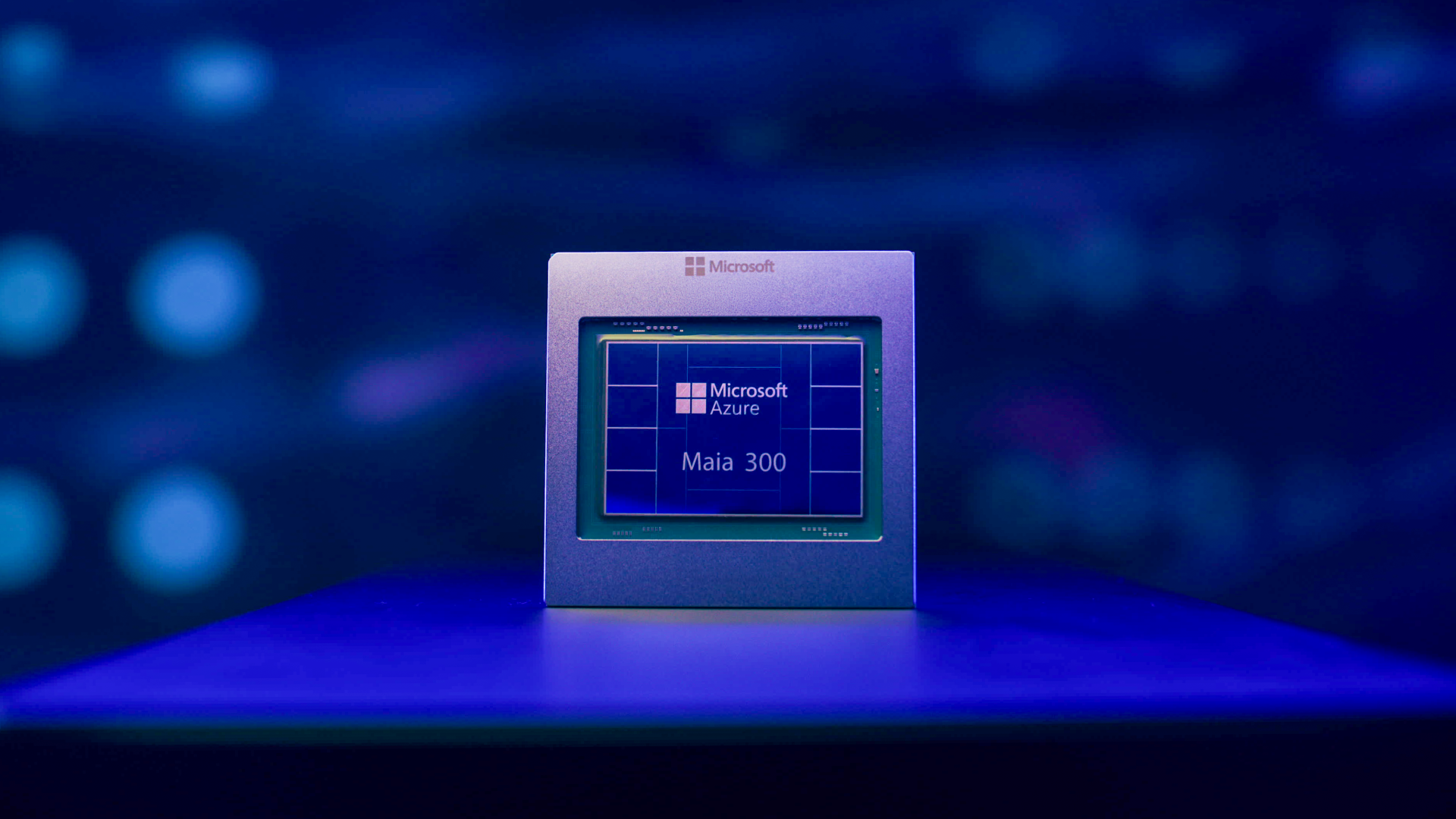
Image: Official hero image of the Microsoft Azure Maia 300 chip (Source: Microsoft)
Anthropic reports progress on anti-distillation measures, but their effectiveness will require long-term evaluation
Anthropic disclosed that early evidence suggests the amount of data attackers can collect has fallen by about 90% to 99% following new measures targeting unauthorized model distillation. Distillation is a common machine learning technique that uses the outputs of a stronger model to train another model; the controversy centers on whether the extraction was authorized and whether service restrictions were bypassed. Anthropic also acknowledged that some protections require legitimate customers to update their integrations, and involve trade-offs in cost and revenue. These results reflect the company’s early observations; they do not mean that all risks of extracting model capabilities have been eliminated.[4]
NVIDIA and Cisco advance high-density optical modules for AI data center interconnects
NVIDIA and Cisco announced the USFP pluggable optical module solution for high-speed transmission within large AI data centers, with design targets including 400 Gb/s per lane and total capacity of up to 12.8 Tb/s. The companies say the new solution can deliver four times the bandwidth density and about 1.3 times the energy efficiency of pluggable optical modules operating at 200 Gb/s per lane. As models grow, efficiency depends not only on the chips themselves, but also on the ability to transmit data among thousands of accelerators. However, moving from specifications and partnership plans to actual production deployments will still require validation of the hardware ecosystem, compatibility, and real-world power consumption.[5]
Briefs
- Architecture startup Blueprints AI introduced a new tool for automatically generating architectural construction drawings. The team emphasized that licensed architects must still review and stamp permit submissions; AI cannot replace professionals’ legal responsibility.[6]
- WindBorne won a U.S. Air Force contract to purchase weather data, with a potential value close to $50 million. Data collected by its autonomous weather balloons can serve customers and is also used to improve AI weather forecasting models.[7]
Editor’s Take
These stories may seem scattered, but they cover the same AI value chain: Meta is trying to help agents better understand ongoing tasks; Microsoft, Nvidia, and Cisco are working to improve the efficiency of the infrastructure that runs these tasks over time; and Anthropic is strengthening the boundaries around model capabilities and data access. It’s worth remembering that a technology demo, an internal test, and a real production deployment are not the same thing. We believe the next phase of competition will likely be decided by whether models can work reliably in specific business settings, whether costs can continue to fall, and whether users can truly control their privacy and security—not simply by leading scores on a benchmark.
Reference Sources
- Meta releases its first frontier model, Muse Wonder — TechCrunch, accessed 2026-10-13
- Introducing Muse Wonder and Muse Wonder Full: Frontier Models for Agents — Meta, accessed 2026-10-13
- Microsoft to expand Azure Maia system to multi-gigawatt deployments — Microsoft, accessed 2026-10-13
- Strengthening our defenses against distillation attacks — Anthropic, accessed 2026-10-13
- NVIDIA and Cisco Introduce New Pluggable Optics Form Factor to Scale AI Factories — NVIDIA Newsroom, accessed 2026-10-13
- This AI startup says it can generate permit-ready blueprints in minutes — TechCrunch, accessed 2026-10-13
- WindBorne wins a hefty US Air Force contract for its balloon data — TechCrunch, accessed 2026-10-13