
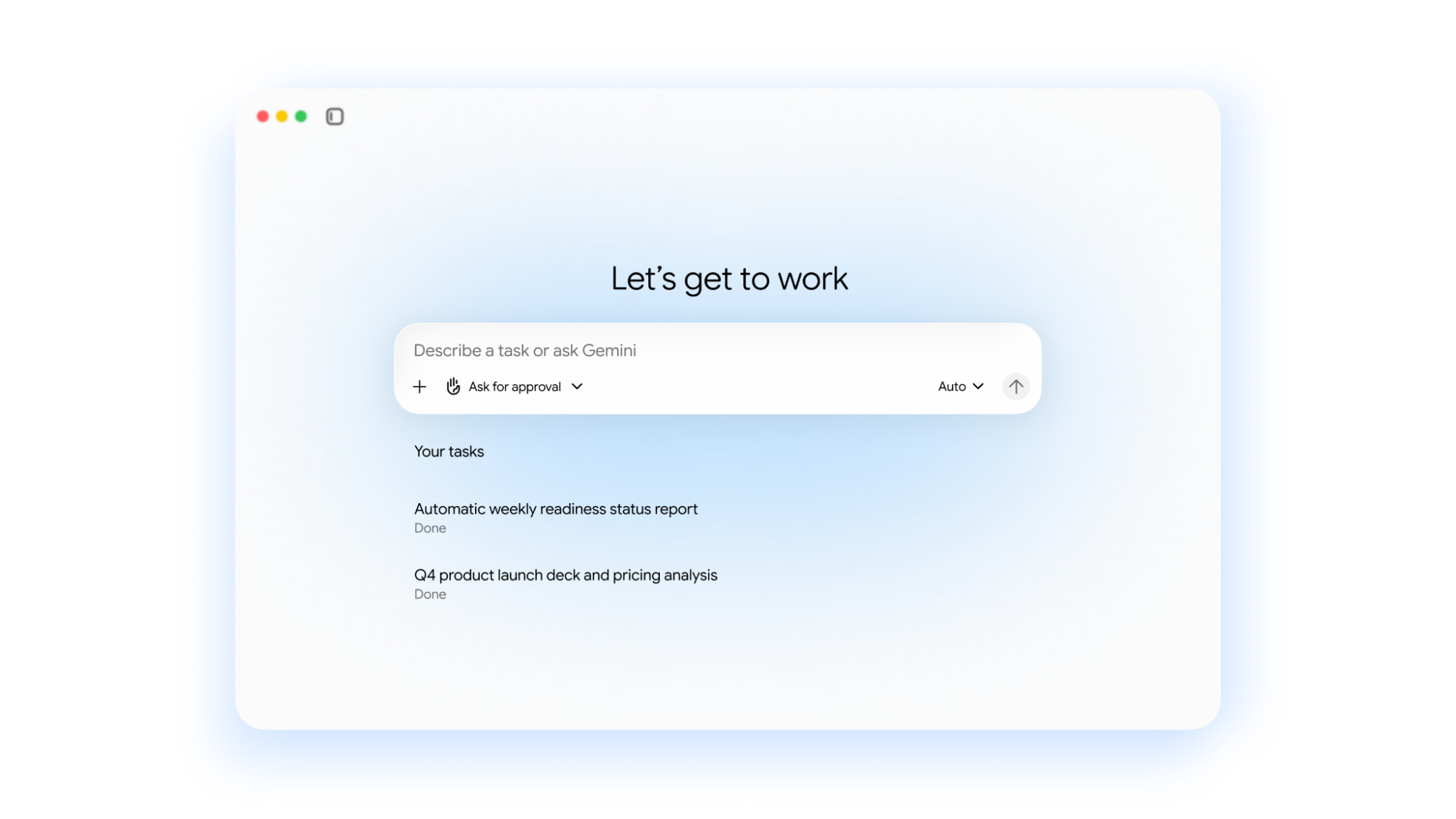
On October 8, 2026, Google Cloud introduced general-purpose Gemini agents for enterprises at the Gemini at Work 2026 event. They’re designed not only to answer questions, but also to carry out tasks across office software, create files, write code, and coordinate other AI agents. Google hopes employees will eventually be able to simply describe a goal and let AI plan the work and deliver the result. This launch points to a new way of working, but the product is still in private preview with a limited number of customers.[1][3]
From chatbots to task executors
Many AI tools today still follow a “user asks—model answers” pattern: ask for the key points in some material, and it provides a summary; ask it to write an email, and it produces a draft. Getting the results into business systems often still requires people to copy, review, and take action step by step.
Google hopes to change this way of interacting. The new agent, as the company describes it, brings together Q&A, knowledge work, media generation, and code execution in a single interface. Users can delegate a goal directly, and the system selects the skills, tools, and models, connects to enterprise data, and returns completed work. It can receive tasks through a variety of entry points, including browsers, phones, desktops, command lines, and collaboration software.[1][2]
The difference isn’t just the addition of automated clicking; it’s that the execution cycle is longer. Google says tasks lasting hours or even days can continue in the cloud. Even if users turn off their computers, the task context and progress are retained. Complex tasks can also be broken down and assigned to temporary teams of subagents to handle multiple steps collaboratively.[1]
Why digital coworkers need their own identities
In ordinary chat tools, AI typically answers using the user’s session identity. But if AI starts acting on behalf of a team to edit files, send messages, and maintain project progress, the question of who performed those actions becomes a governance issue.
Google proposes a “collaborative coworker” model: teams can provision dedicated Workspace accounts, email addresses, calendars, and Drive storage for agents assigned to specific types of work. Team members can mention an agent in a group chat, email it, or ask it to handle something in a document comment. This way, it appears under its own identity in activity records, rather than having all its actions attributed to an employee.[1][2]
For example, a marketing team could set up a campaign coordination agent to summarize launch readiness, draft a checklist, and submit the results in the team’s workspace. Instead of merely generating text, the work is assigned explicitly to a system role that can continue to receive tasks.[1]
But having a separate account doesn’t mean an AI is inherently trustworthy. It might misunderstand instructions, access data it shouldn’t use, or generate inaccurate information. The closer it gets to real work, the more organizations need to define least-privilege access, approvals for critical actions, log reviews, and incident response procedures. Google’s announcement described mechanisms such as dedicated identities, access controls, sandboxes, network policy gateways, and audit logs. These are publicly disclosed product designs, not proof that every use case has already passed security validation.[1]
Software connectivity determines whether AI can deliver real value
Enterprises won’t abandon their existing software just because they adopt AI. Gemini connects to Google Workspace as well as services like Microsoft 365, Slack, Jira, Git, BigQuery, and Postgres. Google also mentions the Model Context Protocol (MCP), a standard interface that lets agents use external tools in a consistent way. [1][2]
Suppose a project manager needs to prepare a status report for the weekly meeting. In theory, the workflow could look like this: retrieve recent changes from chat messages and task systems, access business metrics in a database, compile the report, then submit it through a document tool. One deliverable brings together software operations that were previously spread across multiple systems.
But this only describes the boundaries of what’s possible; it doesn’t mean every enterprise can run the same workflow right away. Inconsistent data fields, incomplete permissions, limited connector coverage, and complex approval requirements can all interrupt execution. Before deployment, enterprises still need to validate against real-world tasks, rather than judging usability from a demo video alone.
Avoid locking agents into a single model
Another technical shift worth watching is Google’s effort to separate “agents that execute tasks” from “the underlying models that handle reasoning.” Its official offering currently supports the Gemini family and Anthropic’s Claude models, with plans to gradually expand the range of options. [1][2]
This means the business context, skills, and tool connections that enterprises build up could remain in a relatively stable agent layer. Different steps could then use models with different costs and capabilities—for example, using a lower-cost model for simple organization and a more capable model for complex analysis. Of course, orchestration across models also brings more challenges around compatibility, privacy, and consistency of results, so it needs to be tested in practice.
Google also announced intelligent routing, project spending limits, and task-pause controls to address the cost of long-running AI tasks. A routine question and a task that runs for hours across multiple systems don’t consume resources on the same scale. Without tracking the combined costs of model calls, code execution, and tool usage, it’s difficult for enterprises to bring AI into their budgets. [1]
From product demos to real-world organizations
Google cited customer examples across industries including finance, retail, and telecommunications. However, these existing Gemini Enterprise customer stories shouldn’t all be taken as evidence that the new general-purpose agent announced this time has been fully deployed. [1]
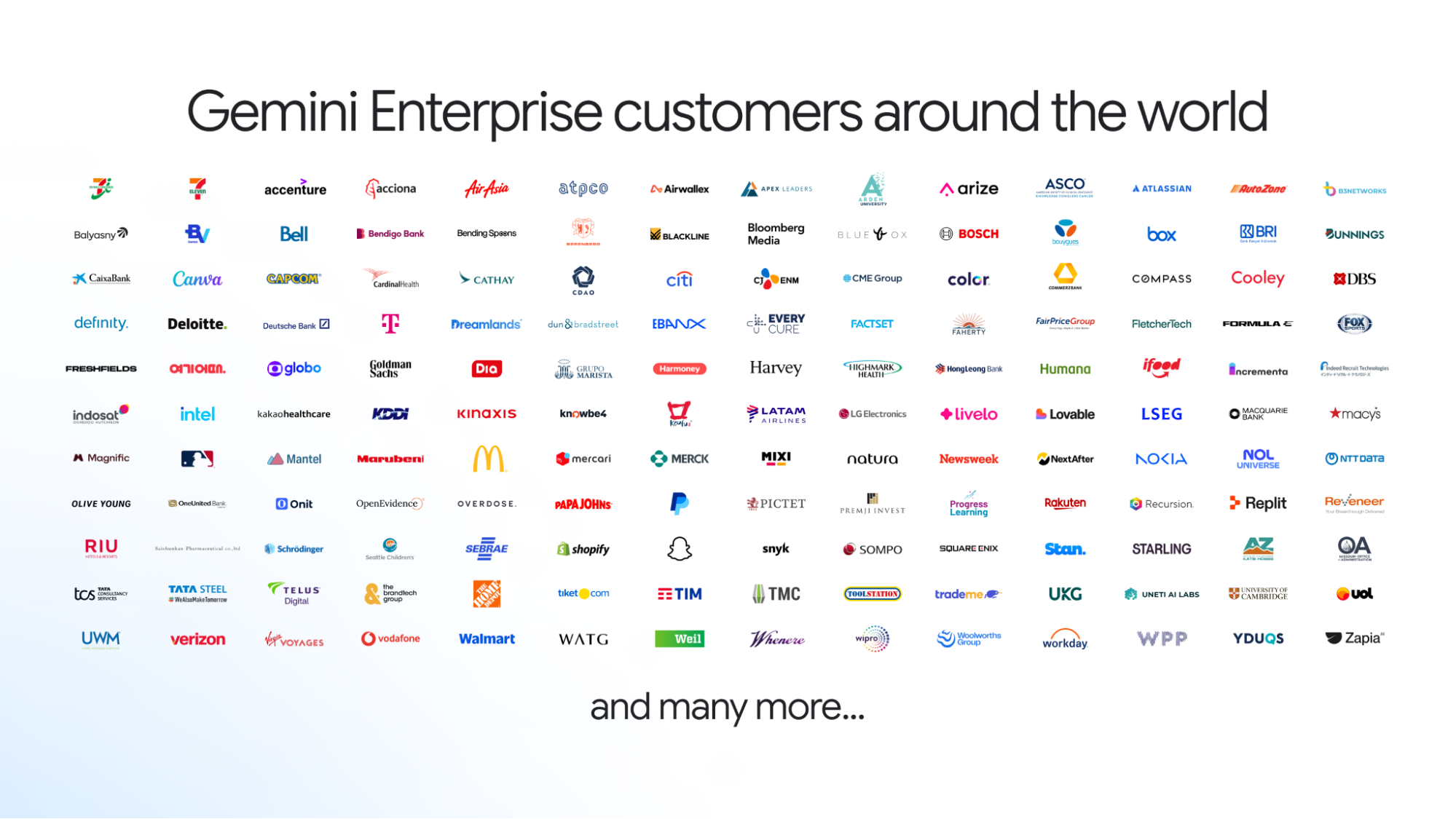
Figure: Gemini Enterprise customer examples announced by Google Cloud (Source: Google Cloud)
A separate VentureBeat report on October 8 confirmed that the new Gemini agents were then available only to select customers in a private preview, with no broader launch date announced. The report also said Google expected to make the new features available to eligible Gemini Enterprise customers, but full licensing and usage costs still awaited further disclosure.[3]
CBS News placed the launch in the context of tech companies racing to introduce AI agents for work. The focus of competition is shifting from how many questions they can answer to whether they can complete tasks safely, reliably, and cost-effectively in everyday systems.[4]
That also explains why the ability to connect with existing workflows may matter more than a single benchmark score. If an agent can’t access the right information or take action within controlled permissions, even a powerful language model may struggle to deliver lasting value.
What This Means for Employees and Businesses
For employees, the most noticeable change is how they work with AI: instead of repeatedly copying AI outputs between different apps, they may eventually be able to state a goal, timeline, constraints, and acceptance criteria as they would when assigning work to a colleague, then review the process and results.
For business leaders, purchasing decisions will become more complex. Beyond the accuracy of the model’s answers, they should consider whether agents have their own identities, whether permissions can be revoked, whether critical actions require approval, whether system errors can be traced, and how many resources a complete task actually consumes.
Google’s announcement points to a clear direction: AI is evolving from an assistant that passively answers questions into an organizationally identified agent capable of working continuously. But the product is still in an early access phase, and more public evidence is needed about its long-term reliability, specific pricing, and performance at scale. It’s reasonable to view this as an important shift in product direction; it’s too soon to treat it as mature digital labor ready to fully replace employees.[1][3][4]
References
- Welcome to Gemini at Work 2026: Introducing the Gemini agent — Google Cloud, accessed October 10, 2026
- Google brings agentic AI to Gemini, starting with businesses — TechCrunch, accessed October 10, 2026
- Google Cloud unveils persistent Gemini Agents for long-running tasks, and they get their own Gmail, Calendar, and Drive storage — VentureBeat, accessed October 10, 2026
- Google launches Gemini AI workplace agent that can write code and run tasks, company says — CBS News, accessed October 10, 2026