
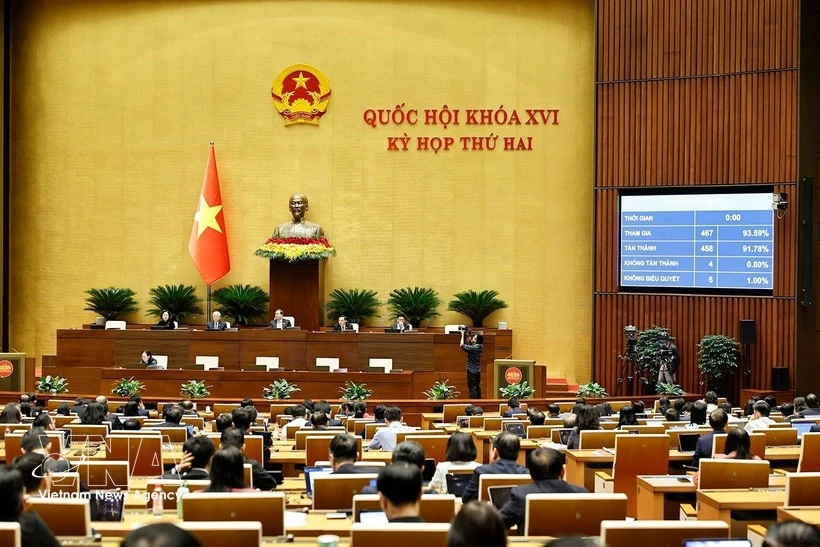
This week’s focus is Vietnam: before closing its second session, the National Assembly passed the Law on Data Security, the Law on Electronic Identification and Authentication, and a series of laws covering investment, taxation, land, and other areas, most of which will take effect in stages in 2027. In China, the Ministry of Commerce announced the continued suspension of certain provisions of its announcement on export controls for dual-use items destined for the United States. The EU, meanwhile, authorized the signing of a Comprehensive Economic Partnership Agreement with Indonesia.
This Week’s Top Story: Vietnam Passes Law on Data Security, Also Covering Entities Processing Vietnamese Data Abroad
What happened. On November 20, the second session of Vietnam’s 16th National Assembly passed the Law on Data Security, comprising 6 chapters and 28 articles, with 468 of the 474 participating delegates voting in favor. It takes effect on July 1, 2027 [1]. Status: Passed, not yet in force. The law establishes principles and measures for protecting data security, defines the rights, obligations, and responsibilities of agencies, organizations, and individuals, and sets out government oversight responsibilities. Its scope extends beyond entities in Vietnam to include foreign organizations and individuals inside or outside Vietnam that process data under Vietnamese jurisdiction or compromise Vietnam’s data security [1]. Reuters reported that the law expands state oversight of sensitive data and cross-border data flows [2].
Background. The session passed 38 laws and 18 resolutions, with security and digital legislation covering national security, data security, electronic identification, and digital transformation, among other areas [3]. According to an explanation provided by Vietnam’s Minister of Public Security before the vote, the Law on Electronic Identification and Authentication distinguishes between mandatory and voluntary electronic identification, requires data collection to be limited to its intended purpose, prohibits duplicate collection of existing data, and removes the requirement to present documents that have already undergone electronic identification [1]. Our previous column focused on Vietnam’s administrative penalty rules for data-related violations; this time, the focus is on establishing data security rules at the statutory level.
Impact. In our view, three types of Chinese-invested businesses will be most directly affected: e-commerce, fintech, and SaaS companies operating in Vietnam that process large volumes of local user and transaction data; providers of cloud services, data centers, or outsourced technology services to Vietnamese clients that process Vietnamese data abroad; and corporate groups with centralized headquarters systems in China that need to transfer data from their Vietnamese subsidiaries back to headquarters. Because the law explicitly covers entities outside Vietnam, “the data is not on servers in Vietnam” no longer means it falls outside the law’s scope [1]. With about 19 months until the law takes effect, now is a good time to map your data: what data leaves the country, who receives it, and on what basis.
What remains unclear. Publicly available information currently consists of official media reports on the voting results and key legislative provisions; the full text of the law has not yet been published in the official gazette. Public reports have not detailed the procedures required for cross-border transfers, which categories of data require assessment, or which authority will grant approvals. These details await implementing decrees, and official releases should be treated as authoritative.

Image: NA Secretary-General and Chairman of the NA Office Le Quang Manh speaks at a press conference on November 21. (Photo: VNA) (Source: Vietnam+ (VietnamPlus))
Top News
Vietnam Amends the Law on Investment and Three Tax Laws: Special Incentives for AI and Chip Projects, Three-Year Tax Exemption for Newly Established SMEs
On November 20, the National Assembly passed amendments to the Law on Investment, the Law on Corporate Income Tax, the Law on Non-Agricultural Land Use Tax, and the Law on Personal Income Tax [4]. Status: Passed, with phased implementation. The amendments to the Law on Investment generally take effect on March 31, 2027; the provisions on the Investment Support Fund take effect upon passage, while the ban on trading electronic cigarettes takes effect on July 1, 2027 [4]. During the same session, the National Assembly also amended laws on trade, competition, foreign trade management, and consumer rights protection [3]. Why it matters: Companies planning to invest in data centers, chip projects, or logistics hubs in Vietnam can assess their eligibility for special incentives in advance. Traders dealing in electronic cigarettes and related accessories will need to arrange an exit or business transition before July 2027.

Image: Prime Minister Le Minh Hung and National Assembly deputies attend the session. (Source: SGGP English Edition)
Ministry of Commerce: Suspension of Paragraph 2 of the Announcement on Dual-Use Export Controls to the U.S. Extended Through January 27 Next Year
On November 24, the Ministry of Commerce issued an announcement stating that, with approval, implementation of Paragraph 2 of Ministry of Commerce Announcement No. 46 of 2024 (Announcement on Strengthening Export Controls on Relevant Dual-Use Items to the United States) will be suspended from November 28, 2026, through January 27, 2027 [5][6]. Status: Announced; effective November 28. The announcement applies to exporters shipping the relevant dual-use items to the United States. It concerns only Paragraph 2; refer to the original Ministry of Commerce announcement for the specific items covered by that paragraph and the implementation arrangements for the remaining provisions. Why it matters: This suspension lasts approximately two months, allowing companies exporting the relevant items to the United States to arrange orders as usual during this period. However, they should use January 27, 2027, as a key planning date for contractual delivery schedules, inventory preparation, and customs declarations, and prepare for both a possible extension of the suspension and the reinstatement of controls upon its expiration.
EU Authorizes Signing of EU–Indonesia Free Trade Agreement; Indonesia to Exit EU GSP Next Year
On November 18, EU member state governments authorized the signing and provisional application of the Comprehensive Economic Partnership Agreement (CEPA) between the EU and Indonesia [7]. Status: Authorized by the Council; pending signature by both parties before submission to the European Parliament for approval. Under the agreement, both sides will eliminate import tariffs on more than 90% of products, most of them as soon as the agreement takes effect; Indonesia’s 50% tariff on EU cars will be phased out within five years [7]. The EU estimates that the agreement could save European businesses around €600 million in tariffs annually [7]. The specific signing date and implementation arrangements remain subject to official announcements. Why it matters: Chinese businesses manufacturing in Indonesia and exporting to the EU will lose Generalized Scheme of Preferences (GSP) benefits starting next year. Whether they can switch to CEPA preferences depends on when the agreement takes effect and its rules of origin, so they should assess their products’ local value added in advance.

Photo: A drone view shows containers being loaded and unloaded at Tanjung Priok Port in North Jakarta, Indonesia, November 2, 2026. REUTERS/Ajeng Dinar Ulfiana/File Photo (Source: The Star (Reuters))
Vietnam Steps Up Enforcement Against Online Counterfeits: Nearly 40,000 Violations Handled in Q3, Counterfeiting and IP Infringement Cases Up 180%
According to the Standing Office of Vietnam’s National Steering Committee Against Smuggling, Counterfeiting and Trade Fraud (Committee 389), government agencies and local authorities handled 39,716 violations in the third quarter of 2026, up 24.38% year over year. These included 34,357 cases of trade and tax fraud and 2,849 cases of counterfeiting and intellectual property infringement, with the latter up 180.69% year over year [8]. Status: Enforcement update. The report noted that offenders are increasingly using Facebook, TikTok, Shopee, Telegram, and livestreams to sell smuggled and counterfeit goods [8]. Why it matters: Chinese sellers using social media and livestream commerce in Vietnam face significantly greater risks if they market goods as “genuine imports” but cannot provide import documentation and proof of the required qualifications. As banking and logistics data become interconnected, flows of funds and goods become easier to trace.

Image: The police and market management forces in Dong Nai city examine a business that is alleged to sell counterfeit brand goods. (Photo: VNA) (Source: Vietnam+ (VietnamPlus))
By the Numbers
- 468/474: Votes in favor of Vietnam’s Data Security Law [1]
- July 1, 2027: Effective date of Vietnam’s Data Security Law, Law on Electronic Identification and Authentication, and revised Land Law [1][2]
- 3 years: Corporate income tax exemption available to newly established small and medium-sized enterprises in Vietnam [4]
- 39,716 cases: Smuggling, counterfeiting, and trade fraud violations investigated and handled in Vietnam in the third quarter [8]
- Over 90%: Share of products for which both parties will eliminate import tariffs under the EU–Indonesia agreement [7]
News Briefs
- Vietnam · Housing and Real Estate: The National Assembly passed the revised Housing Law and Law on Real Estate Business, with the Housing Law receiving 467 votes in favor. The effective date is subject to the official announcement [3]
- Vietnam · Pending Bills: Five draft laws covering maritime and inland waterway transport, food safety, postal services, derivatives trading, and cultural industry development have been discussed and await consideration at subsequent sessions [3]
Editor’s Take
Notably, Vietnam’s latest round of legislation puts “data” and “investment” on the same agenda: the Data Security Law brings entities processing Vietnamese data overseas under regulatory oversight [1][2], while amendments to the Investment Law offer greater incentives for data center, cloud computing, AI, and chip projects [4]. In our view, this means that operating a digital business in Vietnam requires more than licenses and tax compliance—it also demands strong data governance capabilities. Digital infrastructure projects seeking incentives have all the more reason to prepare data security plans early. Meanwhile, enforcement authorities are already integrating banking, logistics, and tax data [8]. For companies expanding overseas, the first half of 2027 will be a key preparation period for compliance in Vietnam, and finance, legal, and IT teams would do well to work from a shared timeline.
What to Watch Next
- November 28, 2026: A new suspension period under paragraph 2 of the Ministry of Commerce’s Announcement No. 46 begins, running through January 27, 2027 [5]
- July 1, 2027: Vietnam’s Data Security Law, Law on Electronic Identification and Authentication, and revised Land Law take effect [1][2]
References
- Lawmakers pass four laws on national security — Nhan Dan Online, accessed on 2026-11-25
- Vietnam passes law to speed up land expropriation for priority projects — TimesLIVE (Reuters), accessed on 2026-11-25
- 16th National Assembly adopts 38 laws, 18 resolutions, completes major workload — Vietnam+ (VietnamPlus), accessed on 2026-11-25
- Vietnam approves three-year corporate tax holiday for newly established SMEs — SGGP English Edition, accessed on 2026-11-25
- Ministry of Commerce: Implementation of Paragraph 2 of the Announcement on Strengthening Export Controls on Relevant Dual-Use Items to the United States Remains Suspended — The Paper (source: Ministry of Commerce website), accessed on 2026-11-25
- Ministry of Commerce Announces Latest Adjustment to Exports of Dual-Use Items to the United States — 21jingji.com (source: CCTV News), accessed on 2026-11-25
- EU governments authorise signature of trade deal agreement with Indonesia — The Star (Reuters), accessed on 2026-11-25
- Authorities step up crackdown on counterfeit goods sold online — Vietnam+ (VietnamPlus), accessed on 2026-11-25