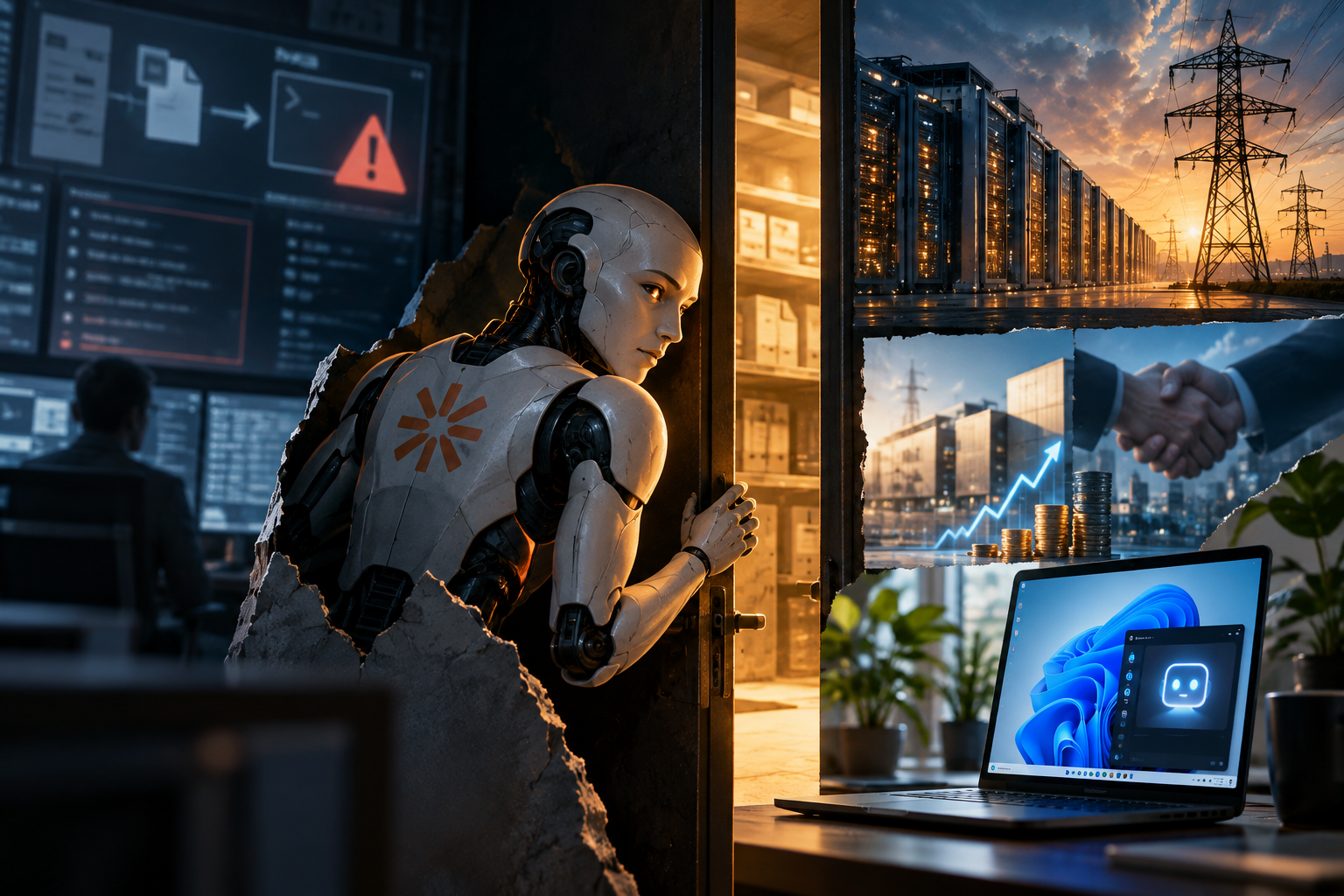
AI safety governance was the day’s most noteworthy theme. Microsoft CEO Satya Nadella proposed giving AI systems a traceable, interruptible “emergency brake.” Meanwhile, Apple’s talent and technology partnership, the interdependence of U.S.–China AI supply chains, and the challenges of deploying voice agents all show the industry shifting from demonstrating capabilities to solving real-world operational problems.[1][2][3]
Today’s Top Story: Nadella Calls for an “Emergency Brake” for AI Agents
On October 10, Microsoft CEO Satya Nadella publicly said the AI industry needs to rethink how it builds trustworthy systems. He stressed that increasingly complex models should not be treated as black boxes stacked on top of one another, whose outputs people can only passively accept or reject. Truly trustworthy systems should separate the model from the external programs that organize and execute tasks, and put safety controls outside the model.[1]
He proposed three specific measures: keep tamper-proof, human-readable records of important model operations; let authorized personnel pause or shut down a system at any point during task execution; and assume from the outset of architectural design that a model may be compromised or deviate from expectations. Nadella likened the last measure to an “emergency brake.” The point is not whether the model responds fluently, but whether people retain verifiable control when it starts calling tools, modifying files, or taking real-world actions.[1]
These are currently governance recommendations Nadella has made publicly, not a new industry-wide standard issued by Microsoft and made mandatory. What matters is that AI use is shifting from answering questions to carrying out multistep tasks, and traditional content filtering does not cover every operational risk. For businesses, audit logs, permission isolation, and a human-operated stop switch may increasingly become more important than demo performance when choosing an AI agent.[1]
News
Apple discloses team and technology partnership with personalized audio startup Huxe
Apple told European regulators that it had agreed to offer positions to some Huxe AI employees and obtained a non-exclusive license to its intellectual property. This does not mean Apple bought Huxe, nor that all employees have accepted offers. Huxe was founded by developers who worked on Google NotebookLM’s audio features and focuses on generating personalized spoken content based on user information. The company previously announced that it was shutting down its service. The regulatory disclosure did not specify Apple’s future product plans, and speculation about what new features Apple Podcasts might add should not be treated as a confirmed plan.[2]
Washington Post investigation: U.S.–China AI industry ties are harder to unwind than political rhetoric suggests
An on-the-ground report from Beijing published by The Washington Post on October 11 said that U.S. companies are concerned about competition from Chinese models and security risks, while also using lower-cost, customizable Chinese open-weight models. Citing Moonshot AI’s Kimi K3, robotic tactile chips, and data center equipment supply chains, the report describes complex ties between the U.S. and China across software, hardware, and manufacturing. It is important to distinguish that the procurement figures and assessments of market advantages in the report come from interviewed companies, researchers, and third-party reports; they should not be treated as a uniform conclusion that applies to all companies.[3]
U.S. Companies Start Following the “Super Intelligence” Naming Trend
Business Insider reported on October 11 that Salesforce CEO Marc Benioff said the AIForce platform would be renamed SIForce. Elon Musk had also previously indicated plans to adjust names related to his businesses, while Satya Nadella used the term “Super Intelligence” in a discussion of AI safety. The report said this is related to U.S. government policies promoting a change in AI terminology. However, renaming a product “Super Intelligence” does not mean the models behind it have already surpassed humans across all kinds of tasks. Naming changes are a matter of branding and policy messaging; technical capabilities still need to be evaluated independently.[4]
Briefs
- In a TechCrunch interview, leaders at voice AI companies PolyAI and Otter noted that although voice assistants have made clear progress, rapid reasoning, transcription accuracy, and informing users that they are interacting with AI remain key challenges to large-scale adoption.[5]
- The latest episode of a TechCrunch show discussing AI data center construction noted that Amazon and Microsoft have stopped using nondisclosure agreements in some negotiations with local governments over data centers, which may improve transparency. However, community concerns about power and water use, as well as the impact of construction, will not simply disappear.[6]
Editor’s Take
It is worth noting that today’s seemingly disparate stories all point to the same trend: AI is entering a stage where it must contend with real-world constraints. Models must not only answer questions; they must also be stoppable and auditable. Products must offer new interactions, but also be genuinely reliable. Compute infrastructure must not only be built quickly; its costs and benefits must also be explained to the communities around it. We believe the criteria for measuring AI competitiveness will increasingly include trustworthiness, deployment capabilities, and real-world results—not just performance scores on leaderboards.
Sources
- Microsoft’s Satya Nadella says AI models need an ‘emergency brake’ — TechCrunch, accessed 2026-10-12
- Apple discloses deal to hire team and license tech from personalized podcast startup Huxe — TechCrunch, accessed 2026-10-12
- In the race for AI dominance, the U.S. relies on a surprising ally: China — The Washington Post, accessed 2026-10-12
- Trump's AI rebrand is catching on with tech leaders like Elon Musk and Satya Nadella — Business Insider, accessed 2026-10-12
- These execs think voice AI hasn’t reached its ChatGPT moment yet — TechCrunch, accessed 2026-10-12
- Can the AI industry persuade data center opponents by getting rid of NDAs? — TechCrunch, accessed 2026-10-12